

Housing policies work best when backed by thorough evaluations. This article explores seven case studies showcasing how cities across the U.S. have assessed and refined their housing strategies to improve affordability, equity, and community well-being. From Detroit's Inclusionary Housing Ordinance to Buffalo's Fair Housing Mobility Program, these examples highlight data-driven approaches that address critical housing challenges.
Key Takeaways:
- Detroit: Used a $250M Affordable Housing Leverage Fund to preserve 12,000 units and develop 2,000 more, while enforcing affordability requirements for subsidized developments.
- Pittsburgh: Tackled a 15,000-unit housing gap with a $10M/year Housing Opportunity Fund, preserving or creating 204 affordable units and stabilizing 1,545 households by 2024.
- Minneapolis: Focused on racial equity with Inclusionary Zoning and homeownership programs, producing 680 affordable units between 2021 and 2023.
- Chicago: Helped high-need families transition to stable housing via intensive case management, improving housing conditions and employment rates.
- Boulder County: Coordinated regional efforts to add 18,000 affordable units by 2035, emphasizing cross-jurisdiction collaboration.
- Buffalo: Launched a mobility program to relocate families to better-resourced neighborhoods, using tailored coaching and financial incentives.
- Cincinnati: Negotiated a Community Benefits Agreement to mitigate displacement risks during stadium development but faced challenges with enforcement and long-term impact.
Quick Comparison
| City | Policy Type | Units Targeted | Funding Approach | Notable Impact |
|---|---|---|---|---|
| Detroit | Preservation Fund | 12,000 units | $250M fund | 1,600 affordable homes generated by 2023 |
| Pittsburgh | Housing Opportunity Fund | 6,300 households | $10M/year tax | Stabilized 1,545 households by 2024 |
| Minneapolis | Inclusionary Zoning | ~300 units/year | Zoning reforms | 680 units created (2021–2023) |
| Chicago | Case Management | 1,400 families | Supportive services | Improved housing and employment rates |
| Boulder County | Regional Partnership | 18,000 units | $10M/year commitment | Increased affordable housing coordination |
| Buffalo | Mobility Program | 1,200+ families | Incentives for landlords | Expanded access to better neighborhoods |
| Cincinnati | Community Benefits Agreement | Not specified | $6.17M over 30 years | Mixed results due to limited enforcement |
These case studies underline the importance of clear goals, dedicated funding, and accountability in housing policy evaluations. Read on for detailed insights into each initiative.
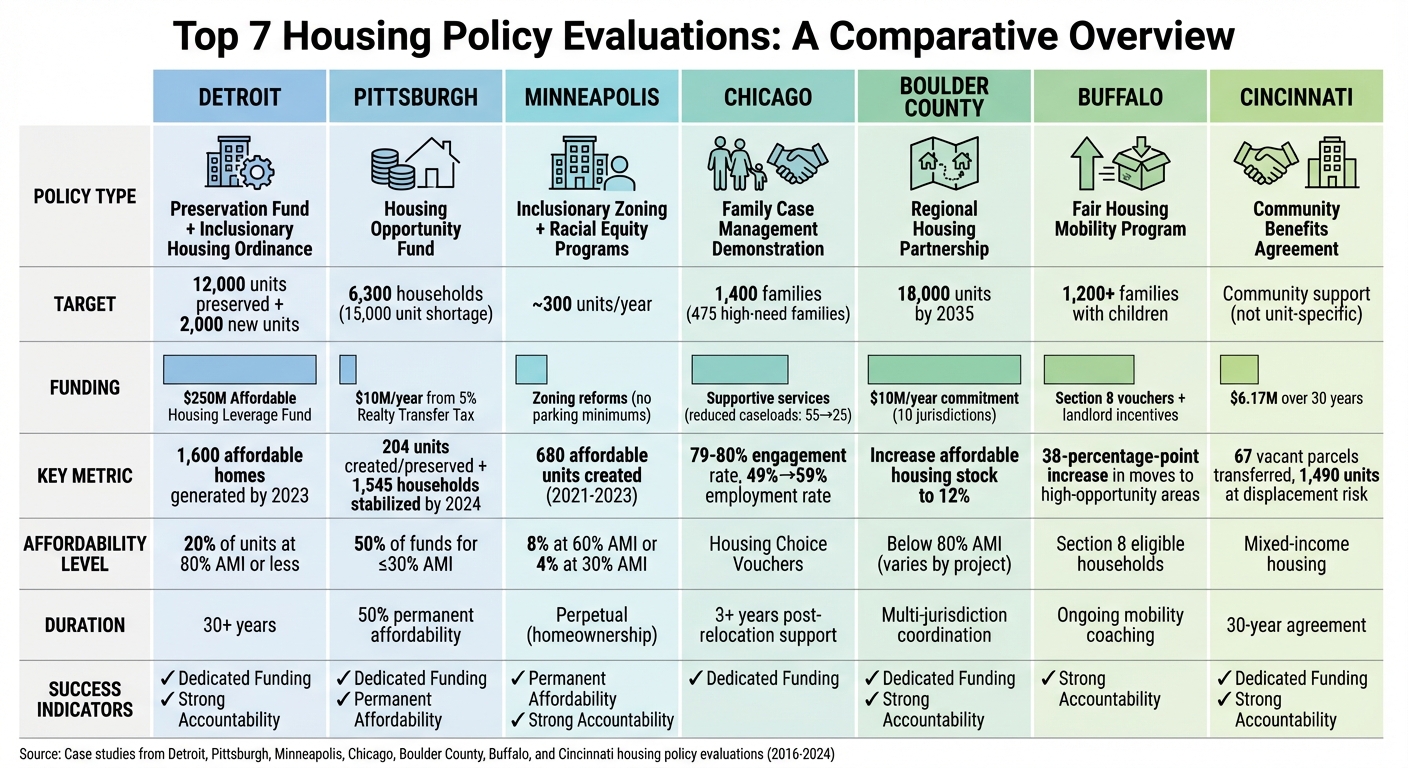
Comparison of 7 U.S. Housing Policy Case Studies: Funding, Units, and Impact
Case Study 1: Detroit's Affordable Housing Preservation
In 2016, Detroit partnered with Grounded Solutions Network through a competitive RFP process to review its housing policies and identify ways to address the gap between local and regional Area Median Income (AMI). The findings from this collaboration helped shape policies that redefined how the city approached affordable housing.
This evaluation led to concrete policy actions. One major outcome was the development of the 2017 Inclusionary Housing Ordinance (IHO). This ordinance requires developers receiving at least $500,000 in public subsidies or discounted city-owned land to allocate 20% of their units to households earning 80% or less of the AMI. This was a critical move for a city where, in 2014, 59% of renters were housing cost-burdened. The ordinance was expected to generate 1,600 new affordable rental homes by 2023.
"Grounded Solutions developed a Preservation Action Plan to take preservation-related goals in our Multifamily Affordable Housing Strategy and translate them into detailed, implementable strategies. They balanced incorporating best practices from around the country with addressing the specific local dynamics and sustainable urban living needs of our city." – Julie Schneider, Associate Director for Policy Development and Implementation, City of Detroit Housing and Revitalization Department
Detroit didn’t stop there. To ensure long-term affordability, the city introduced a financial tool known as the Affordable Housing Leverage Fund (AHLF). This fund aimed to deploy $250 million to preserve 10,000 units and develop 2,000 new units. By late 2019, the AHLF had already allocated $14 million across its first two funding rounds. Early projects showcased the ordinance’s impact:
- The Hamilton: Delivered 93 units, with 33% designated as affordable.
- Third & Grand: Added 231 units, with 20% reserved for households at 80% AMI.
- Sugar Hill Development: Built 84 units, with 25% set aside for those earning between 50% and 80% AMI.
To ensure accountability, Detroit established the Detroit Affordable Housing Development and Preservation Fund, which is supported by penalties for non-compliance and revenue from city property sales. This fund generates about $2 million annuallyfor projects that serve residents earning 50% AMI or less. This approach ensures deeper affordability than market-rate developments typically offer.
Case Study 2: Pittsburgh's Housing Opportunity Fund
Back in 2015, Pittsburgh faced a serious issue: a shortage of 15,000 affordable housing units for households earning below 30% of the Area Median Income (AMI). To tackle this, the city launched the Housing Opportunity Fund (HOF) on January 1, 2018, committing $10 million annually for 12 years. This funding comes from an increase in the Home Rule Realty Transfer Tax, which went from 4% to 5%.
The HOF runs five key programs, each addressing specific housing challenges. The Rental Gap Program initially received the largest share - $3.9 million - to develop or preserve 100 units for households earning 30-50% AMI. This approach quickly showed results. For example, in 2019, a $240,000 loan helped repair three vacant buildings, creating six apartments. That same year, the fund also supported 65 first-time homebuyers and preserved or created 110 housing units.
"You can't start a project if you're $1 million short. You can't do it." – Linda Metropulos, Acting Deputy Director, ACTION-Housing Inc.
Fast forward to 2024, and the HOF's impact is undeniable. It created or preserved 204 affordable housing units, helped 93 households buy their first homes, assisted 52 homeowners with repairs, and stabilized 1,545 households to prevent eviction. The fund prioritizes helping households with the greatest need, allocating 50% of funds to those at or below 30% AMI, 25% to those at or below 50% AMI, and the remaining 25% to those at or below 80% AMI. The HOF carefully evaluates projects based on affordability, location, transit access, and energy efficiency.
The HOF's reach extends further because it can attract additional funding. In 2019, its $10 million allocation helped secure over $67.4 million from other sources. Transparency and community involvement are central to the fund's operations. Annual audits and public surveys (conducted from May to July) ensure accountability, while a 17-member Advisory Board of Pittsburgh residents, along with the Urban Redevelopment Authority Board of Directors, oversees funding decisions to address the city's housing priorities.
Case Study 3: Minneapolis' Inclusionary Zoning and Racial Equity
Minneapolis took a bold step by weaving racial equity into its zoning policies. The city faced a glaring disparity in homeownership: only 20% of Black and American Indian households owned homes, compared to 58% of white households. To address this, Minneapolis introduced an Inclusionary Zoning (IZ) policy in 2020. The policy requires new housing projects with 20 or more units to include affordable housing options: either 8% of units priced for households earning 60% of the Area Median Income (AMI) or 4% for those at 30% AMI. This laid the groundwork for innovative cost-reduction strategies.
To offset the revenue developers might lose by including affordable units, Minneapolis implemented a cost-saving framework under its Minneapolis 2040 Comprehensive Plan. The city eliminated minimum parking requirements and permitted denser developments, significantly cutting construction costs. These measures helped balance the financial impact of the IZ policy. As Zak Yudhishthu, a Policy Analyst, explained:
"This example shows how regulatory reform can 'pay' for the costs of inclusionary zoning, instead of relying on developers to take a cut or the government to provide subsidies."
The results speak for themselves. Between 2021 and 2023, the policy enabled the creation of 680 affordable rental units, averaging 230 units per year. By late 2024, developers had built 616 affordable units - 478 at 60% AMI and just 4 at 30% AMI - showing a clear preference for the less expensive 60% AMI option. Minneapolis didn't stop there; the city also expanded its focus to homeownership equity.
In July 2020, the City Council revamped the Homes: Financing program to support BIPOC developers and ensure affordable homeownership for households earning less than 80% AMI. Later that year, in October, they adopted a Community Preference Policy. This policy reserves up to 50% of new housing opportunities for residents in historically redlined zip codes: 55411, 55412, and 55404. These initiatives aim to tackle the fact that 50% of Black and American Indian households in Minneapolis are burdened by housing costs, compared to 28% of white households.
Together, these reforms reflect Minneapolis' commitment to racial equity and preventing displacement. As the City of Minneapolis noted:
"A community preference policy is one opportunity to undo barriers and overcome inequities created by a history of policies in the City that have prevented equitable access to housing, jobs, and investments."
Case Study 4: Chicago Family Case Management Demonstration
From 2007 to 2010, Chicago launched an initiative to stabilize families facing severe housing barriers. The Chicago Family Case Management Demonstration was a collaborative effort involving the Urban Institute, Chicago Housing Authority (CHA), Heartland Human Care Services, and Housing Choice Partners. It focused on aiding around 475 high-need families from the Dearborn Homes and Madden/Wells developments. These families were often excluded from mixed-income housing due to chronic health issues, mental health struggles, and addiction. The program introduced a new, intensive service model to address these challenges.
A major shift in the program was reducing case managers' caseloads from 55 to just 25 families, allowing for more personalized, home-visit-based support. This support continued for at least three years after relocation and included services such as job placement, financial training, and clinical assistance. Stable housing served as the foundation for delivering these comprehensive services. To better allocate resources, staff grouped families into three categories: striving, aging and distressed, and high risk.
The results were promising. Case manager engagement rates at Wells/Madden increased from 43% to 79%, and at Dearborn from 56% to 80% within the first year. Employment rates also improved, climbing from 49% to 59% between 2007 and 2009. Of the 75 households referred for relocation counseling in the program's first year, 63 successfully transitioned to private-market housing using Housing Choice Vouchers. By 2011, over 75% of participants reported living in better housing conditions, and concerns about neighborhood violence dropped significantly - from over 50% to about 25%.
However, financial struggles persisted. Despite increased employment, wages remained stagnant at around $10 per hour, leaving most households below the poverty line. By 2009, 37% relied on SSI, 68% used food stamps, and 10% received TANF. Health challenges were also prevalent, with over half of participants reporting fair or poor health and high rates of chronic illness. Susan Popkin of the Urban Institute highlighted the ongoing challenge:
"The challenge remains of helping 'the most vulnerable families - those "hard to house" families with multiple, complex problems that make them ineligible for mixed-income housing or unable to cope with the challenges of negotiating the private market.'"
The program demonstrated that while improved housing and safer neighborhoods enhance quality of life, addressing deeper, systemic issues requires intensive, wraparound services. The findings emphasized that future efforts must prioritize career growth and wage increases to help families truly escape poverty. This case underscores the importance of holistic approaches in housing policy evaluations.
Case Study 5: Boulder County Regional Housing Partnership
In 2020, Boulder County launched a collaborative effort to tackle one of Colorado's toughest housing challenges. The Boulder County Regional Housing Partnership united the City of Boulder, the City of Longmont, and Boulder County through a formal Intergovernmental Agreement (IGA). The goal? To add 18,000 affordable housing units by 2035, increasing the region's stock of permanently affordable housing to 12%. For context, Boulder had just 7.2% in 2014.
The partnership's structure emphasizes accountability across jurisdictions. By August 2020, all 10 jurisdictions in Boulder County had endorsed the plan, committing staff and at least $10 million annually to create 8,000 new units over 15 years. To keep the public informed, the "Home Wanted" website tracks progress and engages officials, serving as a transparency tool.
Local governments have also stepped up with policy changes. For instance, the Town of Superior adopted an Inclusionary Housing Ordinance in 2020-2021. This requires developments with 10 or more units to allocate at least 15% for households earning below 80% of the Area Median Income (AMI). The City of Longmont planned a 73-unit permanently affordable housing project, completed in Spring 2022. Meanwhile, Boulder Housing Partners used the MTW program to renovate 275 public housing units, adding 26 affordable homes and securing over 5 acres for future projects.
The partnership's efforts earned it NACo's Best in Category Award for Human Services. Cross-jurisdictional working groups have been pivotal, allowing planners and developers to share expertise. Smaller towns contribute land, while larger cities provide financial resources, creating a balanced, collaborative approach. This method helps communities address their unique challenges while advancing shared goals. The partnership builds on earlier cooperative housing initiatives, highlighting the value of regional coordination and accountability in housing policy.
Despite these achievements, funding remains a hurdle. A recent evaluation showed that while funding for homelessness services rose by 22% from 2022 to 2023, emergency response services grew by 27%, and long-term housing and support increased by only 17%. Heidi Grove, Division Manager of the Division of Homeless Systems and Coordinated Response, explained the underlying issue:
"The systems that exist today exist due to a scarcity of resources, which have been significantly underfunded for decades... Now, it will require all systems working together to invest in housing, behavioral health services, and wraparound services."
This partnership underscores how tracking progress and fostering collaboration can lead to tangible results. However, ensuring consistent funding for permanent housing solutions remains a pressing challenge.
Case Study 6: Buffalo's Fair Housing Mobility Program
In 2024, Buffalo joined New York State's Making Moves Program (MMP), an initiative that helps Section 8 Housing Choice Voucher holders with children under 18 move to neighborhoods with better opportunities. Locally managed by Housing Opportunities Made Equal (HOME), the program focuses on relocating families to areas with enhanced access to economic prospects and quality community resources.
A key tool in this program is the Neighborhood Resource Index (NRI), which scores neighborhoods on a 0–100 scale based on factors like economic conditions, education quality, and demographics. Participants work closely with mobility coaches who provide tailored assistance with housing searches, financial planning, and application processes. To encourage landlords in these high-resource neighborhoods to participate, the program offers direct support for Section 8 procedures and financial incentives, such as help with security deposits.
"Making Moves is now helping families in... Buffalo... expand their housing options to neighborhoods in 'well‑resourced areas,' in order to expand access to economic mobility, high‑performing schools, job opportunities and other positive long‑term outcomes."
– NYS Homes and Community Renewal
Although long-term data specific to Buffalo's program is still being gathered, findings from the similar Moving to Opportunity (MTO) program offer valuable insights. Within five years of relocating to lower-poverty neighborhoods, participants reported notable improvements in personal safety and housing conditions. Additional benefits included better mental health for adults, reduced obesity rates, and, among teenage girls, higher school retention and fewer risky behaviors. However, the study also revealed no significant changes in adult employment or children's educational performance during the first five years. This suggests that while safer, better-resourced neighborhoods improve well-being, lasting economic mobility may take more time and require expanded support services beyond housing assistance.
Buffalo's program highlights a thoughtful, data-informed strategy to reduce concentrated poverty. By combining the NRI scoring system, one-on-one coaching, and government support for housing initiatives, the initiative establishes a well-rounded framework for assessing mobility-focused housing solutions. This groundwork sets the stage for further evaluation in Case Study 7.
Case Study 7: Cincinnati's Community Benefits Agreement
In 2018, as FC Cincinnati began building the $250 million TQL Stadium in the West End - a neighborhood where 90% of residents rent and many face displacement concerns - the city negotiated a Community Benefits Agreement (CBA) valued at $6,170,000 over 30 years to help address rising rents and related challenges.
The CBA included several housing-focused measures: $100,000 was allocated for a housing study to assess displacement risks, $50,000 was set aside for a communications consultant to engage residents on affordable housing needs, and 67 vacant property parcels were transferred to The Port of Greater Cincinnati Development Authority for affordable, mixed-income housing projects. Additionally, $100,000 per year was earmarked for community-building initiatives. By 2021, FC Cincinnati had already contributed $100,000 for emergency housing assistance and $200,000 to The Port for affordable housing efforts.
A notable feature of the agreement gave the West End Community Council full contractual standing, meaning it could pursue mediation or legal action if the terms were not upheld - provided three-quarters of its 12-member coalition approved. To oversee implementation, the mayor also formed a 17-member Community Advisory Council to ensure communication among all parties.
Despite these provisions, critics like attorney Kristen Myers and community advocate Alexis Kidd have pointed out weaknesses in the agreement. Limited negotiation time and a lack of clear benchmarks have made enforcement difficult. A housing study found that 1,490 rental units - nearly 48% of renter-occupied housing - remained at risk of displacement, and advocates estimate that thousands of residents may have already been displaced as developers purchased nearby properties.
This case illustrates both the strengths and shortcomings of CBAs. On one hand, the agreement secured funding and legal mechanisms to address community needs. On the other hand, the roughly 10 hours of negotiation were insufficient to establish strong accountability measures. Participation in oversight committees also declined over time, exacerbated by the COVID-19 pandemic, which made online meetings inaccessible for residents without reliable internet. Cincinnati’s experience underscores the need for thorough negotiation, clear accountability metrics, and long-term engagement to ensure CBAs can address housing challenges effectively. It offers important lessons for evaluating housing policies and their impact on vulnerable communities.
Comparison of Housing Policy Evaluations
The seven case studies highlight a variety of housing policy approaches, each differing in goals, funding, and evaluation methods. For instance, Detroit aims to preserve 12,000 units through a $250 million fund, Pittsburgh supports 6,300 households with a $10 million annual tax, and Minneapolis produces around 300 units annually with a focus on perpetual affordability for homeownership.
| Case Study | Policy Type | Target Units | Affordability Duration | Primary Funding/Outcome |
|---|---|---|---|---|
| Detroit | Preservation Plan / Leverage Fund | 12,000 units (target) | 30+ years | $250M fund deployment |
| Pittsburgh | Housing Opportunity Fund | 6,300 households | 50% permanent | $10M/year transfer tax |
| Minneapolis | Inclusionary Zoning / Shared Equity | ~300 units/year | Perpetual (homeownership) | Citywide zoning reform |
| Chicago | Family Case Management | 1,400 families served | N/A | Supportive services focus |
| Boulder County | Regional Partnership | Regional coordination | Varies by project | Multi-jurisdiction approach |
| Buffalo | Fair Housing Mobility | 1,200+ participants | N/A | AFFH compliance framework |
| Cincinnati | Community Benefits Agreement | Community support | Not specified | $6.17M over 30 years |
Each initiative uses tailored evaluation methods to gauge its impact. Pittsburgh and Buffalo, for example, applied the federal Affirmatively Furthering Fair Housing (AFFH) framework to assess reductions in segregation and expanded opportunities. Minneapolis used a mix of data analysis and community feedback during its zoning reforms. In contrast, Cincinnati’s Community Benefits Agreement lacked clear benchmarks and enforcement mechanisms, making its impact harder to measure.
One clear takeaway is that mandatory housing policies consistently outperform voluntary incentives in producing units. A nationwide study of 258 inclusionary zoning policies revealed that mandatory requirements deliver far more housing than voluntary programs. Broad jurisdictional policies also prove more effective than those targeting specific neighborhoods, as they prevent developers from sidestepping regulations by relocating projects to exempt areas.
The most effective programs share three key elements:
- Dedicated funding streams: Examples include Pittsburgh’s annual transfer tax and Detroit’s leverage fund.
- Permanent affordability mechanisms: Minneapolis’s perpetual homeownership model and Pittsburgh’s 50% permanent affordability requirement stand out.
- Strong accountability structures: Clear benchmarks and enforcement mechanisms ensure long-term success.
Andrea Brennan, Director of Housing Policy and Development for Minneapolis, emphasized the importance of expert guidance in crafting impactful policies:
"Grounded Solutions' assistance was absolutely essential in our work to craft an effective and impactful inclusionary housing policy."
These case studies offer valuable insights and practical lessons to inform future housing policy design.
Lessons for Future Housing Policies
The examples from Denver and Seattle highlight that successful housing policies require more than just funding - they thrive on detailed evaluations, collaboration across sectors, and a strong focus on fairness. By combining rigorous studies with long-term data tracking in areas like housing, justice, and healthcare, these initiatives demonstrate how thoughtful strategies can create meaningful change.
Take Denver’s Supportive Housing Social Impact Bond Initiative (2016–2021) as an example. This program used a randomized controlled trial to evaluate 724 individuals experiencing chronic homelessness. Over three years, participants gained an additional 560 days of housing, achieved a 77% retention rate, and saw significant reductions in shelter stays (40%), jail days (27%), and detox service use (65%). Even better, about half of the annual per-person cost was offset by a drop in emergency service expenses, proving the program’s efficiency.
Seattle’s Creating Moves to Opportunity project (August 2017 to February 2019) offers another inspiring case. By tackling practical barriers, the Seattle Housing Authority and King County Housing Authority, in partnership with InterIm CDA, provided housing navigators for 499 families. This effort led to a 38-percentage-point increase in moves to high-opportunity neighborhoods. The benefits extend beyond housing: children in these families are projected to enjoy an 8.3% boost in lifetime earnings.
These initiatives show that success depends on partnerships between multiple agencies and clear cost-benefit analyses. For future policies, integrating housing authorities, justice systems, and healthcare providers ensures a broader focus on residents’ well-being. Transparent evaluations also help secure long-term funding by showing how local investments reduce state and federal emergency costs. Shifting resources from reactive responses to proactive housing solutions not only saves money but also creates lasting benefits for individuals and communities.
FAQs
What makes a housing policy evaluation “rigorous”?
A thorough evaluation of housing policies relies on systematic and well-structured methods to assess their impact. This process often involves longitudinal data analysis, control groups, and clearly defined metrics to measure outcomes. Core elements include experimental or quasi-experimental designs, robust data collection practices, appropriate statistical methods, and transparent reporting. These strategies are essential for generating reliable evidence to guide policy decisions and improve the effectiveness of housing programs.
What metrics best indicate if affordability rules prevent displacement?
Rent stabilization policies often aim to help low-income residents stay in their neighborhoods, providing security and continuity. Key metrics include how well these measures achieve that goal and how protections like just cause eviction policies work in practice. While these policies can offer significant benefits to certain groups, the overall outcomes are not always clear-cut. In some cases, these measures might inadvertently leave others without the same level of support, creating a complex balance of benefits and challenges.
How can cities enforce accountability in housing programs over time?
Cities can ensure accountability in housing programs by implementing clear monitoring systems to track progress on objectives like increasing affordable housing and minimizing displacement. Regularly assessing outcomes - such as housing stability and resident satisfaction - helps gauge the program's success. Additionally, transparent reporting and data-driven policy adjustments keep initiatives aligned with community needs. This approach builds public trust and ensures consistent oversight.