

Running a successful coliving space isn't just about managing rooms - it's about creating a connected community where residents want to stay. Missteps like unclear communication, weak house rules, or neglecting community-building efforts can lead to high turnover and costly operations. Here’s a quick breakdown of the most common mistakes and how to avoid them:
- Poor Communication: Miscommunication causes 60% of conflicts. Avoid this by onboarding residents properly, enforcing a 48-hour response policy, and using tools like Slack or Zendesk for updates and issue tracking.
- Unclear House Rules: Vague policies lead to disputes over noise, guests, and shared spaces. Set specific rules for quiet hours, guest limits, and kitchen use, and enforce them consistently with clear consequences.
- Skipping Community-Building: Strong community programs can increase renewal rates from 18% to 43%. Plan events, allocate 3–5% of revenue for activities, and hire a dedicated Community Manager for properties over 100 residents.
- Overlooking Costs: Turnover costs average $4,200 per resident. Track expenses like utilities, maintenance, and supplies carefully, and use tools to streamline financial management.
- Outdated Listings: Misleading photos or virtual tours hurt trust and increase vacancies. Regularly update visuals, show real spaces, and use tools like Matterport for 3D tours.
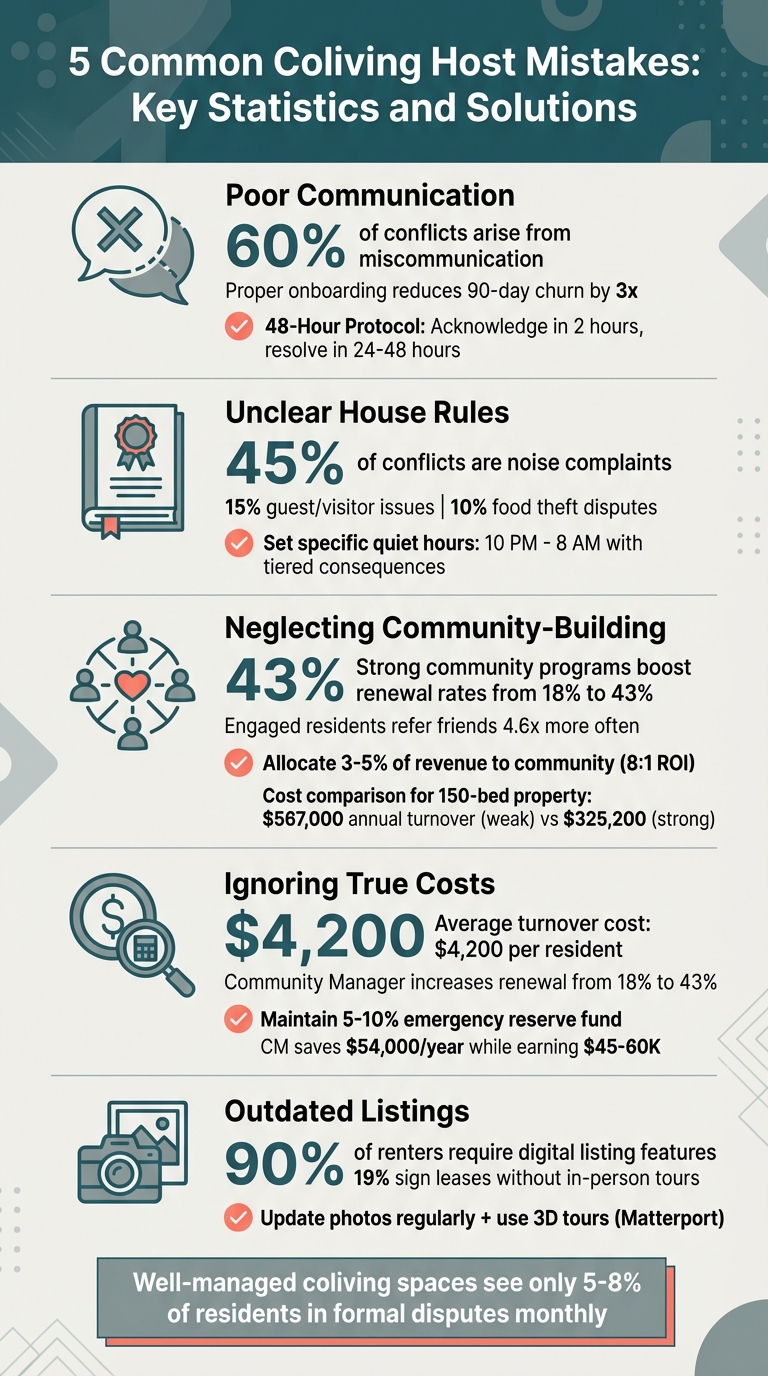
5 Common Coliving Host Mistakes: Key Statistics and Solutions
Mistake 1: Poor Communication with Residents
Communication missteps can seriously hurt your bottom line. When residents are left wondering who to contact, how to report issues, or what’s expected of them, trust starts to crumble. And the numbers don’t lie: around 60% of coliving conflicts arise from miscommunication or mismatched expectations - not deliberate bad behavior.
Skipping proper onboarding during the first 24 hours can have a huge impact. It triples the churn rate within 90 days, leading to significant turnover costs. Neglecting to hold 1-on-1 intro meetings or facilitate roommate introductions on day one sets the stage for problems to snowball.
Timely responses are just as crucial as clear communication. Ignored maintenance requests or complaints leave residents feeling undervalued, prompting them to look for alternatives. A simple solution? Implement a 48-Hour Protocol. Acknowledge complaints within 2 hours and provide a detailed resolution plan within 24–48 hours. This approach keeps small issues from escalating into major headaches.
Fragmented communication tools can also cause trouble. Important messages get lost, creating chaos. For larger properties, tools like Intercom or Zendesk help track response times and ensure nothing slips through the cracks. For everyday updates, platforms like Slack provide organized channels and real-time notifications. If your property houses over 100 residents, hiring a full-time Community Facilitator can help balance operational needs with resident engagement.
Another common issue is inconsistent rule enforcement. Nothing frustrates residents more than seeing some people get away with breaking rules while others face consequences. This is especially true for noise complaints, which make up 45% of all coliving conflicts. Clear communication about quiet hours - typically 10 PM to 8 AM - and consistent enforcement can prevent many of these problems before they even arise.
Once you’ve nailed down effective communication, the next step is establishing clear and consistently enforced house rules.
Mistake 2: Lack of Clear House Rules
Once communication is in place, the next step is making sure everyone knows the house rules. Clear rules form the backbone of any successful coliving space, helping to avoid misunderstandings and arguments. When rules are vague or nonexistent, people tend to make their own assumptions - and those assumptions rarely align. The numbers tell the story: 15% of conflicts stem from guest and overnight visitor issues, while 10% come from problems like food theft and fridge disputes. These aren't personality clashes - they're the result of unclear policies.
The problem often starts during onboarding. Many hosts hand over a lease and assume everyone understands what proper coliving etiquette means. But what seems obvious to one person might not be to another. For example, what one resident considers a reasonable music volume might feel like a noise violation to someone else. Without clear guidelines, you’re left playing referee more often than you'd like.
Setting Key Policies for Smooth Daily Living
The best way to avoid daily friction is to address the most common problem areas upfront. Quiet hours, for instance, should be specific, not vague. Many well-run coliving spaces set quiet hours from 10 PM to 8 AM, with clear consequences: a friendly reminder for the first violation, a written warning for the second, and a $50–$100 fine for the third. Guest policies should also be detailed. Differentiate between day visitors and overnight guests, require advance notice for overnight stays, and limit them to 2–3 nights per month. If someone’s partner starts staying over regularly, a 10–20% monthly surcharge can help cover increased utility costs and wear and tear.
Kitchen rules are another big one. To keep things running smoothly, assign specific, labeled cupboards and fridge shelves to each room. Require residents to label all food items with their name and date, and schedule weekly fridge cleanouts. For repeat offenders who ignore these rules, a $100 fine for a second violation can send a clear message.
Using Digital Tools to Share and Enforce Rules
Paper rulebooks tend to get lost or forgotten. Digital tools, on the other hand, make it easy to keep rules accessible and enforceable. Platforms like Slack or Discord are great for daily communication and updates, with dedicated channels for announcements, maintenance requests, and group discussions. For storing and sharing policies, tools like Notion or Airtable create searchable databases that residents can access anytime.
To manage shared responsibilities like chore rotations or booking common spaces, Google Calendar can be a lifesaver. Some hosts even use apps like Loomio to involve residents in decision-making, allowing them to vote on rule updates or propose new policies. This not only keeps the rules relevant but also helps residents feel invested in the community.
Digital tools also make enforcement easier. Instead of relying on memory, log rule violations with timestamps and details. For example, if a noise complaint comes in, document it. This record-keeping protects you in case disputes escalate and can help you spot patterns, like a single resident repeatedly breaking the same rule.
Make sure to update your digital rulebook regularly based on resident feedback. Quarterly surveys can help you identify what’s working and what isn’t. A well-functioning community typically sees only 5–8% of residents involved in formal disputes each month. If your numbers are higher, it’s time to revisit your rules. Plus, when residents feel heard, they’re more likely to recommend your space - 4.6 times more often, in fact.
With clear rules and digital enforcement in place, you can shift your focus to building stronger community connections.
Mistake 3: Neglecting Community-Building Efforts
What sets coliving apart from simply renting a room is the sense of community it fosters. When hosts overlook this crucial element, residents often feel isolated, and the overall operation takes a hit. The numbers speak for themselves: strong community programming can boost renewal rates from 18% to 43%. For a 150-bed property, this difference could mean annual turnover costs of $567,000 for weak communities versus $325,200 for strong ones.
Beyond the financial strain, neglecting community leads to poorly planned events that fail to engage residents. Without meaningful connections, conflicts like noise complaints or messy kitchens - issues that make up 70% of all resident disputes - become more frequent and harder to resolve.
The fix? Intentional planning and a dedicated budget. Operators who allocate 3–5% of total revenue to community-building efforts see an impressive 8:1 ROI. For instance, a $30,000 annual community budget for a 150-bed property can yield significant returns. Engaged residents also become advocates, referring friends 4.6 times more often than disengaged ones, effectively creating a no-cost marketing channel.
Planning Events to Build Connections
A successful community program requires more than sporadic pizza parties or last-minute gatherings. The goal is a balanced schedule that caters to various interests. For a 150-bed property, aim for 8–10 events per month, spanning:
- Social activities like community dinners or game nights
- Professional development through expert talks or coworking sessions
- Wellness events such as yoga classes or group hikes
- Cultural experiences like heritage nights or museum trips
Start with onboarding: meet with new residents one-on-one within their first 24 hours and introduce them to their roommates. Some hosts even implement a "Buddy System", pairing newcomers with existing residents to ease their transition. For larger properties (100+ residents), hiring a full-time Community Manager - someone experienced in hospitality, events, or education - can make all the difference.
Once you’ve nailed down your programming, it’s time to ensure the physical space encourages organic interactions.
Designing Spaces for Social Interaction
The layout of your coliving space can either encourage connections or hinder them. Thoughtful design choices can make a big impact. For example:
- Interior windows between common areas and hallways create visibility and draw people into activities.
- Moveable furniture allows spaces to adapt, serving as coworking areas by day and social hubs by night.
- Single walkways encourage spontaneous encounters, while acoustic panels help maintain a lively atmosphere without disrupting work or rest.
In common areas, opt for seating arranged in conversation-friendly clusters rather than rows facing a TV. Create distinct zones like a quiet reading nook, a collaborative work table, a game area, and a communal dining space. These intentional layouts make it easier for residents to naturally cross paths, strike up conversations, and form connections.
Mistake 4: Ignoring Unit Economics and True Costs
Once you've fine-tuned communication and community policies, the next piece of the puzzle is managing the financial side of your coliving space. Just like clear rules and engaging programs can reduce conflicts and turnover, smart financial management ensures that hidden costs don't quietly eat away at your profits.
It's easy to focus on the monthly rent flowing in while overlooking the smaller, less obvious expenses that can pile up. One of the biggest culprits? Churn and turnover costs. Every time a resident moves out, it costs operators an average of $4,200. For a property with 150 beds and poor retention, this can balloon into a staggering $567,000 annually.
Bundled utilities can also become a financial trap. Since coliving often includes utilities in the rent, unexpected spikes in electricity, water, or gas usage come directly out of your pocket. On top of that, recurring costs like quarterly air conditioning maintenance, pest control, and cleaning supplies can quietly chip away at your margins.
To avoid these pitfalls, you need a clear and honest look at your expenses. Break them down into three main categories:
- Infrastructure costs: Initial expenses like security deposits, furniture, and repairs.
- Ongoing costs: Recurring expenses such as rent, utilities, cleaning, and supplies.
- Discretionary costs: Extras like community events and property upgrades.
By calculating your costs per unit, you can get a better understanding of your true expenses and make more accurate financial projections. Let’s take a closer look at where money often disappears and how to keep it under control.
Breaking Down Hidden Costs
Hidden costs have a way of sneaking up on you. Maintenance and unexpected repairs - like fixing a leaky faucet or replacing a broken appliance - can quickly add up when you're managing multiple units. For example, in 2020, Gramercy House in New York faced a major setback when a ceiling collapsed due to water damage, forcing them to replace $2,000 worth of furniture immediately.
Then there are supplies and consumables. Items like cleaning products, paper towels, and shared kitchen basics may seem minor, but they add up fast when you're supplying them for dozens of residents. Another often-overlooked expense is the cost of community management. Properties without a dedicated Community Manager (CM) experience renewal rates as low as 18%, compared to 43% for properties with one. A skilled CM, earning $45,000–$60,000 annually, can improve retention enough to save operators $54,000 per year, effectively paying for their own salary.
Here’s how traditional rentals compare to coliving from the host's perspective:
| Expense Category | Traditional Rental | Coliving (Host Perspective) |
|---|---|---|
| Utilities | Paid by tenant | Bundled (Host risk) |
| Cleaning | Tenant responsibility | Professional service included |
| Furniture | Tenant provided | Upfront host investment |
| Marketing | One-time per unit | Continuous for individual rooms |
| Turnover | Low frequency | High frequency (requires systems) |
Once you've identified these costs, the next step is to streamline how you track and manage them.
Using Financial Tools to Track Expenses
Managing multiple units with manual spreadsheets can quickly become overwhelming. Instead, opt for property management software that integrates with your bank feeds. This can reduce processing costs by up to 78% and eliminate manual errors, giving you real-time insights into your spending.
Make it a habit to conduct monthly variance reviews to catch any unexpected cost increases early. Implement zero-based budgeting each year, where you re-evaluate every expense from scratch instead of relying on last year's numbers. This approach helps weed out unnecessary spending on outdated services or subscriptions.
For utilities, consider using smart building controls or programmable thermostats, which can cut energy costs by 15–25%. Reassess vendor contracts annually to ensure you're getting the best rates for cleaning, maintenance, and supplies. Finally, maintain an emergency reserve fund equal to 5–10% of gross rents to cover unexpected repairs or vacancy gaps without scrambling for cash.
Mistake 5: Using Outdated Photos or Listings
Your listing photos are often the first - and sometimes the only - chance to make an impression on potential residents. In fact, nearly 90% of renters say that digital listing features like photos, 3D tours, and walkthrough videos are must-haves when searching for a home. Yet, many hosts rely on outdated images or a single "model unit" that doesn’t reflect the current state of the property. This creates a gap between what renters expect and what they actually encounter.
This mismatch can be a major trust-breaker. When potential residents arrive and see something different from the polished images in your listing, it damages your reputation. It also increases costs - higher turnover rates and additional marketing expenses to fill vacancies. High-quality prospects won’t stick around; they’ll move on to listings that feel more transparent and trustworthy. To avoid this, keeping your visuals fresh and varied is key.
Start by updating your photos regularly, especially after renovations, furniture updates, or rebranding efforts. Show off all available floorplans with tailored walkthrough videos, and go beyond empty rooms by featuring images of residents enjoying the space. Capture moments like cooking together, working in shared areas, or attending events. These photos not only showcase the physical space but also give a sense of the community vibe that sets coliving apart.
For a more immersive experience, consider using tools like Matterport to create 3D tours, allowing renters to explore remotely. Clear walkthrough videos from a renter’s perspective are also effective - especially since about 19% of renters sign leases without an in-person tour, and most only visit once. However, avoid over-editing or using AI to fabricate amenities. If virtual staging is necessary during renovations, clearly label these images to maintain transparency and credibility.
"Your virtual tours accomplish one of two things. They either attract and qualify prospective renters... Or they force prospects to quickly move on because your visuals are outdated, uninformative, and misleading." - Michael Zimmerman, RentVision
Accurate, professional visuals don’t just draw more attention - they attract the right residents. These are the people who know exactly what they’re signing up for and are more likely to stay long-term. By prioritizing high-quality, up-to-date images, you can reduce turnover, improve resident retention, and create a thriving coliving community.
Final Thoughts
To successfully run a coliving space, it’s essential to focus on the basics. Clear communication helps avoid misunderstandings, while well-thought-out house rules provide structure without feeling stifling. Building a sense of community turns a shared living space into a place where people genuinely feel at home. Staying on top of finances ensures operations remain both sustainable and profitable, and accurate marketing attracts the right residents who know exactly what to expect.
Thriving coliving hosts understand that community isn’t just a nice-to-have - it’s the heart of the experience. This requires going beyond basic management to actively encourage connections. For example, implementing strong onboarding programs with a "buddy system" can help new residents integrate smoothly. Regular check-ins, like surveys or open forums, allow you to adapt as the needs of your residents shift over time.
Interestingly, the size of the group plays a big role in fostering community. Studies suggest that groups of around 20 people strike the perfect balance - large enough for meaningful interaction but small enough to manage effectively. One coliving space in London found that 68% of residents felt their social lives improved because of the host’s carefully planned events. That’s a clear indication that intentional effort makes a difference.
Carefully selecting residents based on shared values or lifestyles - whether they’re digital nomads, entrepreneurs, or creatives - can create a more harmonious living environment. Transparency about what’s included in the rent, like utilities, cleaning services, or Wi-Fi, also helps avoid financial surprises. Practical financial guidelines outlined in house rules ensure fairness while keeping the space running smoothly.
FAQs
What should I cover in a new resident onboarding?
When welcoming a new resident, it’s important to provide them with the essential details they need to feel at home and understand how things work. Share practical information like access codes, Wi-Fi passwords, trash pickup schedules, and any house rules. Make sure to also mention upcoming community events and ways they can connect with neighbors.
Don’t forget to provide clear contact information for support, and walk them through tools for handling rent payments and maintenance requests. These steps can go a long way in making new residents feel comfortable and helping them settle into the community with ease.
How do I enforce house rules without causing drama?
To keep things running smoothly at home, start by making the rules crystal clear. You can do this through written guidelines or by discussing them during house meetings. When everyone understands the expectations from the get-go, it helps avoid confusion later.
If someone breaks a rule, address it respectfully. Start with a polite conversation - it’s often enough to resolve minor issues. If the problem continues, follow up with a written notice. Save more serious steps, like formal warnings or mediation, for situations where other approaches haven’t worked.
The key is to stay calm and focus on mutual respect. Whether it’s about noise levels or shared chores, tackle common issues head-on. Clear communication and a fair approach can help create understanding and keep tensions low.
When should I hire a Community Manager?
When your coliving space is up and running, bringing in a Community Manager can make a big difference in creating a lively and connected environment. As your community expands, this role becomes key to boosting resident engagement, coordinating events, and ensuring smooth communication. Having someone focused on these efforts helps strengthen relationships among residents, increases satisfaction, and encourages people to stay longer. Plus, it helps you avoid common pitfalls like miscommunication or overlooking the importance of fostering connections.