

Want your coliving space to stand out? It all starts with a clear, memorable brand. A strong brand not only attracts the right residents but also increases retention and boosts revenue. Here’s how to build a brand that resonates:
- Define your values and mission: Identify what drives you and align your operations with principles like inclusivity or affordability. Clear values help attract long-term residents.
- Highlight what makes you different: Pinpoint unique features, like competitive pricing models or flexible leases, to address specific market needs.
- Craft a mission statement: Keep it concise (under 30 words) and focus on how you serve your audience.
- Create a visual identity: Use consistent logos, colors, and designs to build trust and make your space recognizable.
- Tell compelling stories: Share real resident experiences to connect emotionally with your audience.
- Leverage your online presence: Focus on social media platforms where your audience is active and optimize your website and listings for clarity and ease of use.
- Track performance: Use metrics like occupancy rates and feedback to refine your branding efforts.
Define Your Core Values and Mission
Your core values aren't about hitting business targets - they're the principles that shape how you achieve those goals. For example, while full occupancy might be a goal, values like inclusivity, affordability, or community-focused living guide how you reach it. These values don't just shape your operations; they attract residents who share your vision, forming the backbone of a genuine and thriving community. Let’s dig into how you can identify these principles.
Start by reflecting on what drives you. A helpful tool is the "5x Why" exercise: write down why you want to run a coliving space, then ask yourself "Why?" or "So what?" five times. This process uncovers your deeper motivations. Next, picture your ideal community. What are its top five defining characteristics? These qualities will form your core values.
This approach isn't just theoretical - it works. A LinkedIn Workforce Confidence survey found that 42% of workers would accept a pay cut to work for a company whose values align with their own. The same logic applies to housing. When your values resonate with residents, they’re more likely to stay longer and recommend your space to others.
Identify What Makes Your Coliving Home Different
Think about the housing landscape in the U.S.: 73% of households are small, yet only 12.5% of available housing consists of studios or one-bedroom units. If your coliving space bridges this gap with affordable, thoughtfully designed small units, that’s a key differentiator.
Other standout features might include a central location, engaging community programs, or flexible lease options. These are not just perks - they directly address what residents value. For example, property owners who focus on workforce housing and transition homes to coliving models have seen Net Operating Income more than double. This success comes from zeroing in on specific market needs rather than trying to cater to everyone.
Write a Clear Mission Statement
Your mission statement should be concise yet meaningful - short enough to remember, but detailed enough to guide your decisions. Aim for under 30 words and make sure it answers four key questions: What need are you addressing? How are you addressing it? Who are you serving? What sets you apart?
"The best mission statements define a company's goals in at least three dimensions: What the company does for its customers, what it does for its employees, and what it does for its owners." - Tim Berry, Entrepreneur
Draft your mission statement and test it with trusted residents, team members, or partners. Focus on the how rather than just listing goals. For instance, instead of saying, "We provide affordable housing", you might say, "We create affordable, community-driven homes where young professionals can thrive in high-cost cities." The second version not only states what you do but also highlights how you’re different.
Create a Visual Identity
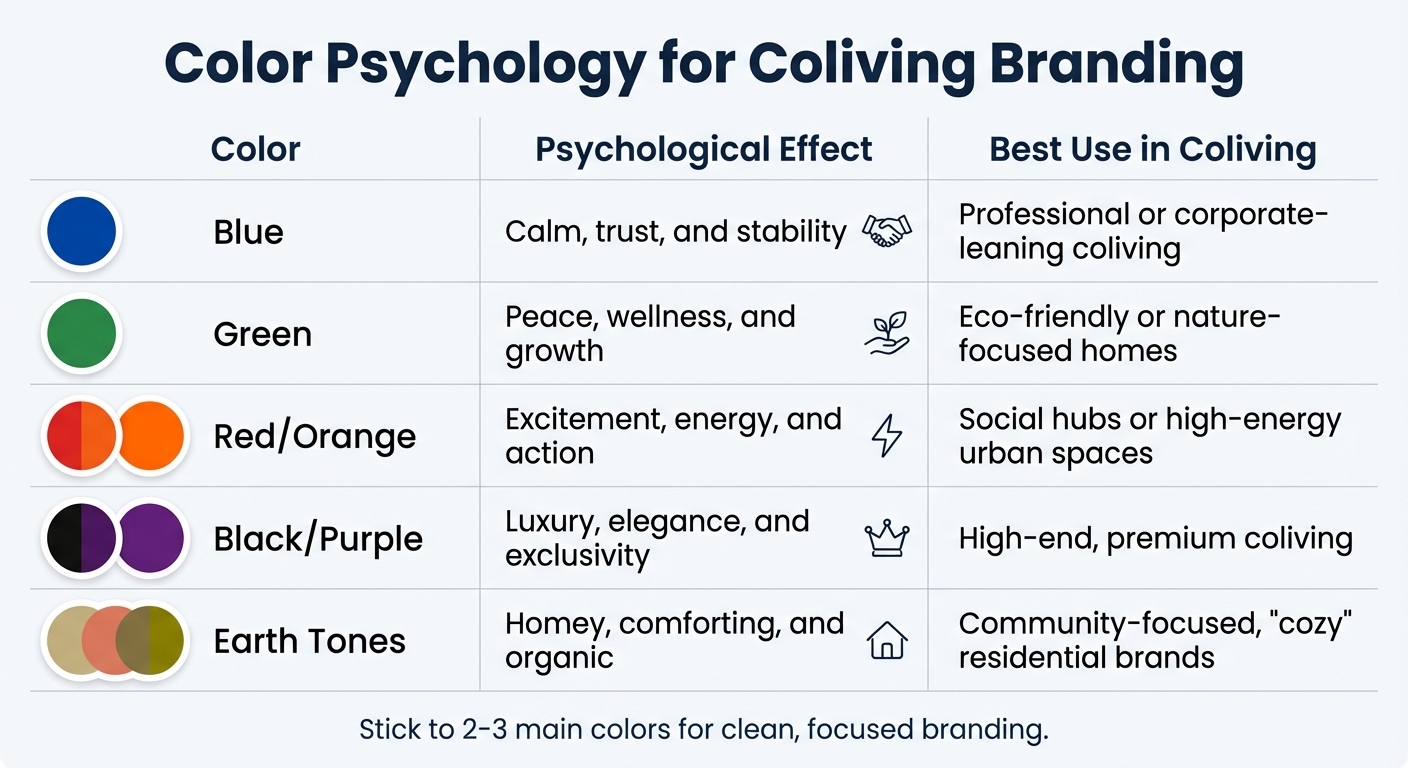
Color Psychology Guide for Coliving Branding
Once you've nailed down your core values, it's time to translate them into a visual identity. This isn't just about looking good - it’s about making your coliving space instantly recognizable while reinforcing your mission. Here’s why it matters: the human brain processes visuals 60,000 times faster than text, and people form judgments about your brand in just 50 milliseconds. Your logo, colors, and fonts act as quick signals, telling people what your brand stands for before they even read a word.
A strong visual identity includes a logo, a defined color palette, typography, a photography style, and graphic patterns. These elements work together to create a sense of predictability. Why does that matter? Because predictability builds trust. For example, when residents see the same colors on your Instagram and your website, it creates a sense of comfort and reliability. And trust pays off - brands that maintain consistent visuals across platforms see an average revenue boost of 23%.
Choose Colors and Designs That Match Your Brand
Colors do more than make things look pretty - they evoke emotions and set the tone for your brand. The colors you choose can help attract the right residents and reflect the community vibe you're aiming for. For instance, minimalist white space paired with cool blues signals innovation and calm - perfect if you’re targeting urban tech professionals. On the other hand, bold reds and oranges scream energy and excitement, making them ideal for a vibrant, creative crowd. The key is aligning your color palette with both your core values and your audience’s expectations.
Here’s a quick breakdown of how colors can shape perception:
| Color | Psychological Effect | Best Use in Coliving |
|---|---|---|
| Blue | Calm, trust, and stability | Professional or corporate-leaning coliving |
| Green | Peace, wellness, and growth | Eco-friendly or nature-focused homes |
| Red/Orange | Excitement, energy, and action | Social hubs or high-energy urban spaces |
| Black/Purple | Luxury, elegance, and exclusivity | High-end, premium coliving |
| Earth Tones | Homey, comforting, and organic | Community-focused, "cozy" residential brands |
Stick to two or three main colors to keep your branding clean and focused. Document the exact color values - HEX codes for digital use (like #0066CC) and CMYK or Pantone values for print materials. And don’t forget to test your color combinations for accessibility, ensuring they meet WCAG standards so everyone can easily read your content.
Design Logos and Visuals for Consistency
Your logo is the face of your brand, so it needs to work everywhere - from your website to a tiny social media icon. Simple designs tend to scale better and stay versatile. Decide whether a wordmark (text-based logo), a symbol (graphic-only), or a combination of both fits your brand best. For example, a wordmark might suit a coliving space with a distinctive name, while a symbol works well if you want a global, language-independent icon.
If you’re creating your logo yourself, tools like Canva are beginner-friendly, while Adobe Illustrator offers more advanced control. But if design isn’t your strength, consider hiring a professional through platforms like Upwork. A professional can help you create a full brand style guide, which is essential for keeping your visuals consistent. This guide should cover everything: logo placement, font styles, color codes, and rules for how your visuals appear across various platforms.
Here’s why consistency matters: 90% of consumers expect a brand’s experience to be the same across digital and physical spaces. Your logo and visual elements are the glue that holds your brand together, ensuring that no matter where your residents interact with you, they feel the same sense of trust and familiarity.
Tell Stories That Connect With Residents
Your visual identity might grab attention, but it's the stories you tell that truly resonate with residents. While stunning visuals can stop someone mid-scroll, heartfelt stories are what create lasting connections. People don’t choose coliving spaces just for the amenities or square footage - they’re looking for a sense of belonging. In fact, word-of-mouth recommendations are trusted seven times more than direct marketing. The secret? Make your residents the stars of your stories, while positioning your brand as their trusted guide. As Faith Barker, Manager of National Client Marketing at Greystar, explains:
"If we're not the hero, we want to be the ally or the mentor - the sidekick that makes their journey easier. You don't want to be the dragon, the villain that serves as an obstacle."
Share Real Resident Experiences
The most powerful stories come straight from the people who live in your community. Encourage your on-site staff to identify residents whose lives have been positively impacted by your space. These individuals can provide testimonials, participate in interviews, or even be featured in "day-in-the-life" stories that showcase authentic moments.
Take this example: In 2025, a senior living community in the Midwest shared an unscripted video of a resident who initially felt nervous about moving in but quickly discovered a warm and welcoming environment. The video, shared via email and Facebook, led to an 18% increase in tour requests and doubled email click-through rates within 60 days. Authenticity, not perfection, is what strikes a chord. As Khara House, Owner/Founder of CASA Communities, puts it:
"The goal is not to be overly polished or perfect. It's to be personable."
Highlight a variety of resident stories - whether it’s a new arrival, a long-term member, a couple, a solo professional, or a remote worker. To share these moments effectively, make sure you have signed consent forms and use regular resident surveys to uncover fresh narratives. These genuine stories can then be tailored to reflect what makes your community special.
Write Stories That Appeal to Your Target Audience
Once you’ve collected these real-life stories, refine them to fit the needs and values of your prospects. Focus on themes that matter most to them: connection, freedom, and a sense of belonging. Match your stories to different stages of the decision-making process. For those just learning about your community, share uplifting stories about friendships and lifestyle. For prospects further along, highlight stories that address concerns or solve problems.
A great example of this approach is Greystar's "Expect Campaign." In 2025, Faith Barker led a student housing initiative that prioritized resident feedback, focusing on their desires and frustrations instead of treating them as mere revenue sources. This strategy led to a 43% increase in retention, a 33% rise in occupancy, and over $1 million in additional annual revenue. By framing your coliving experience as a choice for freedom - freedom to live among like-minded people and on your own terms - you can turn hesitation into curiosity, and curiosity into action. Short-form videos are especially effective for showcasing these authentic moments.
When done well, resident-driven stories not only highlight the everyday life in your community but also reinforce the promise your brand makes to its residents.
Build Your Online Presence
Your online presence is what transforms hidden gems into well-known, trusted coliving spaces. It’s more than just being visible - it’s about showcasing your core values and the stories that make your space special. The secret lies in choosing the right platforms and making them consistently reflect your brand.
Use Social Media Effectively
Social media is your bridge to connect with potential residents. Instead of spreading yourself thin across every platform, focus on 1–3 platforms where your target audience is most active. For example, 76% of marketers say Instagram is the go-to platform for building brand awareness, while YouTube and TikTok both rank at 73% for boosting exposure.
Encourage your residents to share their experiences using a unique hashtag. Reposting this real-life content builds trust, as 83% of customers are more likely to engage with brands that feature authentic user stories.
Engagement goes beyond just posting. Responding to comments and questions makes your audience feel seen. Drew Balis, Social Media Manager at Wix, suggests that while instant replies aren’t necessary, responding within 24 hours shows you value your community. Dedicate time daily to interact with your followers - it’s worth it.
| Platform | Audience Reach | Strengths | Best Practices |
|---|---|---|---|
| High (Visual-focused) | Visual storytelling, property aesthetics | Share home tours, resident highlights, and aesthetic "vibe" shots. | |
| TikTok | Younger (Gen Z/Millennials) | Viral potential, authentic, unfiltered content | Post creative short videos of events and daily life. |
| Professionals/B2B | Networking with digital nomads and corporates | Highlight workspace features, industry insights, and milestones. | |
| Broad/Local | Community building, event promotion | Promote events, share updates, and engage in local groups. |
While social media gives your brand personality, your website and listings are where that personality turns into action.
Optimize Your Website and Listings
Think of your website and Coliving.com listing as your digital storefront. They should clearly communicate what sets you apart and why someone should choose your space. Start with high-quality photos that go beyond just the rooms - show residents collaborating, sharing meals, or enjoying the common areas. These images should highlight the lifestyle your space offers.
When crafting your Coliving.com listing, use precise language to describe your community. Avoid vague terms like "modern and comfortable." Instead, say something like, "A creative hub for digital marketers and designers who thrive on collaboration", or "A peaceful retreat for remote developers seeking focus." Specificity attracts the right residents and can lead to direct booking rates as high as 80%.
Make booking simple. Display pricing, move-in dates, and what’s included clearly, and outline the next steps. Consistency matters too - ensure your website, listings, and social media all share the same voice, colors, and branding. Every interaction should reinforce the feeling you want your space to convey.
Measure and Improve Your Brand's Performance
Building a strong brand isn't a one-and-done task - it requires constant attention and refinement. To stay on track, you need to monitor key metrics and adapt based on what the data tells you.
Start by tracking measurable outcomes like occupancy rates, lease renewals, and the success of premium pricing. These indicators can reveal how well your brand resonates with residents and prospects. Another important metric is your lead-to-lease conversion rate. As Stacey Feeney, Founder & Creative Director at Zipcode Creative, explains:
"When your branding is well developed, well received, AND consistent, your prospects are more likely to accept your pricing... and your residents more likely to renew their lease year over year."
Research backs this up: improving brand recognition and loyalty can drive a 2% increase in annual revenue.
But numbers only tell part of the story. To get a fuller picture, dive into the perceptions and experiences of your residents. Ask them directly: "Would you recommend us to family or friends?" Follow up with a comment box for additional insights. Keep an eye on online reviews - Google, Facebook, and other platforms are goldmines for understanding public sentiment. Tools like Brand24 can help you monitor your online reputation. As Aitana de Jong, Managing Partner at Spatial Experience, puts it:
"A brand and the community around it are a living organism, so gathering feedback, fine-tuning and adjusting accordingly are part of a relentless maintenance process."
Your website analytics can also shed light on how well your brand connects with potential residents. Metrics like direct traffic (indicating brand recall), time on site (showing interest), and bounce rate (potentially signaling a mismatch in messaging) are especially useful.
Final Thoughts
Building a brand for your coliving home is all about defining who you are and expressing it consistently. Every piece - your core values, visual identity, stories, and online presence - should come together to create an experience that truly connects with your residents. This alignment lays the groundwork for fostering real, meaningful connections.
At the heart of it all is staying true to your identity. As Matt Capra aptly says:
"Community is the essence of coliving. Beyond sharing a home, coliving residents seek authentic connections with like-minded individuals."
When your brand embodies this spirit, it becomes more than just a name or logo - it becomes a meaningful part of your residents' lives. For example, a coliving space in London found that 68% of its community reported an improved social life thanks to a well-organized event schedule. This shows how authentic community experiences can create tangible, positive outcomes.
Consistency is key. When every touchpoint - whether it's your website or the welcome guide - delivers the same message and promise, it builds trust and a sense of familiarity.
Your brand should also adapt as your community grows and changes. Think of it as a living, breathing identity that evolves over time. By listening to feedback and tracking performance, you can fine-tune your approach. The most successful coliving operators treat their brand as a shared identity - one that includes residents, staff, and stakeholders working together.
FAQs
How do I choose a niche for my coliving brand?
When deciding on a niche for your coliving brand, start by identifying a specific market segment that matches your interests, skills, and the unique qualities of your property. Think about factors like market demand, location, and how well you can cater to a particular community's needs.
For instance, you might focus on eco-conscious travelers who value sustainable living or digital nomads seeking flexible, community-driven spaces. The key is to find a niche with enough demand to sustain your business while avoiding markets that are overly saturated with competitors.
Once you've chosen your niche, tailor your services and amenities to meet the expectations of your audience. This effort will help you build a deeper connection with your community and stand out in the coliving space.
What should I include in a simple brand style guide?
A simple brand style guide should include a few key elements to keep your coliving home’s identity consistent and recognizable:
- Brand identity and messaging: Define the tone, personality, and core values that represent your brand. These act as the foundation for how your brand communicates and connects with people.
- Design guidelines: Outline typography, color palettes, and imagery rules to maintain a uniform look across all materials.
- Logos and visuals: Provide clear instructions on logo usage, including size, placement, and variations to avoid misuse.
- Communication standards: Set standards for voice, tone, and messaging to ensure all communication reflects the brand’s character.
Together, these components create a unified and professional presence for your coliving home.
Which numbers best show if my branding is working?
When evaluating the success of your branding efforts, keep an eye on these key metrics: resident retention rates, lease renewal rates, and residents’ willingness to pay a premium. A well-crafted brand builds trust and recognition, which often translates to longer tenancies and a higher perceived value of your offerings. Regularly tracking these numbers can give you a clear picture of how your branding is influencing your coliving community.