

Blockchain is changing how housing works by replacing middlemen with automated systems like smart contracts and DAOs. This allows for transparent accounting, automated rules, and affordable investment options. Real-world examples include:
- Reental (Malaga, Spain): Raised €409,500 in 2024 through tokenized ownership, offering 10.10% annual dividends.
- Pangea (Brooklyn, NY): Tokenized a five-unit building in 2018, enabling fractional ownership and automated rent distribution.
- RealT (Detroit, MI): Tokenized over 400 properties but collapsed in 2026 due to unpaid taxes and poor property management.
- CityDAO (Wyoming): Bought 40 acres in 2021 under a DAO LLC, combining blockchain governance with land ownership.
Blockchain offers potential for rental automation, decentralized governance, and community funding, but it also poses risks, as RealT's failure shows. These case studies highlight both opportunities and challenges in blockchain-based housing.
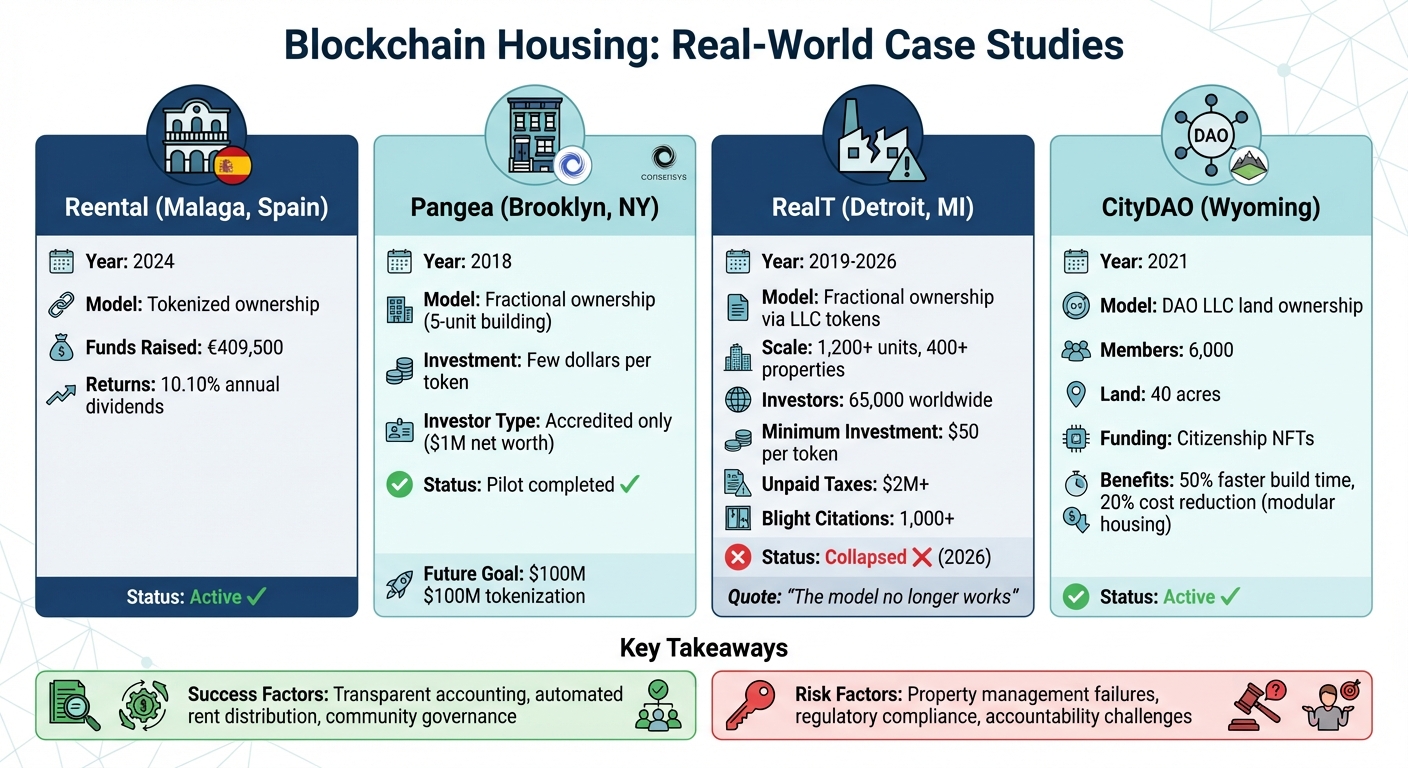
Blockchain Housing Case Studies: Key Metrics and Outcomes Comparison
ConsenSys Housing DAO in Brooklyn
In March 2018, ConsenSys introduced Pangea, a project to tokenize a five-unit apartment building in Bushwick, Brooklyn. Co-founders Mohammad Shaikh and Corbin Page collaborated with Cayuga Capital Management and Cushman & Wakefield to explore fractional ownership using Ethereum smart contracts.
Tokens were sold for just a few dollars each, though participation was restricted to accredited investors under U.S. securities regulations. These investors needed a net worth of $1 million or an annual salary of $250,000 for two consecutive years. Through smart contracts, the system automatically distributed rental income to token holders in proportion to their ownership, bypassing traditional intermediaries like title insurance companies and lawyers.
"Pangea is disrupting a famously illiquid market by giving investors the freedom to trade with other users instantly. Investors can sell a piece quickly rather than having to deal with intermediaries such as title insurance, brokers, lawyers, and realtors." - Mohammad Shaikh, Co-founder of Pangea
One of Pangea's key contributions was addressing information asymmetry in real estate. By storing all property-related data, such as past sales, repairs, and amenities, on the blockchain, the platform created what Corbin Page described as "a common view of an individual property." This approach eliminated the usual lack of transparency in real estate transactions, ensuring all token holders had equal access to critical decision-making information.
After the Brooklyn pilot, ConsenSys set its sights on tokenizing $100 million worth of real estate across the U.S., with similar plans for Dubai and Germany. The project demonstrated how blockchain technology can make traditionally illiquid real estate assets easily tradable by automating revenue sharing and governance. This initiative not only highlighted blockchain's potential in modernizing real estate but also paved the way for future innovations in coliving and housing solutions.
RealT's Tokenized Coliving Properties in Detroit
After the Brooklyn experiment, Detroit became the stage for another bold attempt at blockchain-driven real estate. RealT, founded in 2019, introduced fractional ownership to Detroit's housing market using blockchain technology. The company managed over 1,200 housing units across 400+ properties, tokenizing each property on the Ethereum blockchain. Investors could buy in for as little as $50 per token. For instance, a $60,000 home could be divided into hundreds of tokens and sold worldwide in mere seconds. However, these tokens represented shares in an LLC that owned the property, rather than direct ownership on the deed.
This approach quickly gained traction, drawing over 65,000 investors worldwide. RealT promised weekly rental income payouts in cryptocurrency, which attracted a global audience. Interestingly, RealT excluded U.S. citizens from investing, as It targeted international buyers under SEC Regulation S exemptions. While these foreign investors earned passive income, Detroit residents lived in the properties - a setup that later sparked significant backlash.
By early 2026, RealT's model had completely unraveled. Weekly payouts to investors stopped, and the City of Detroit filed a massive nuisance abatement lawsuit against the company, implicating 165 related corporate entities. RealT owed over $2 million in unpaid taxes and faced more than 1,000 blight citations. Some properties had racked up over $16,000 in tax debts or were fined $10,000 daily. Meanwhile, tenants reported severe living conditions, including black mold, collapsed ceilings, no running water, and broken heating systems.
"No matter how innovative your business model may be, you cannot hide behind technology or corporate formalities to evade your responsibilities as a property owner." - Conrad Mallett, Corporation Counsel for the City of Detroit
In July 2025, a Wayne County Circuit Court judge issued a temporary restraining order. The order prohibited RealT from collecting rent until the properties met compliance standards, redirecting rent payments to escrow accounts for repairs. By March 2026, RealT informed investors via email that "The model no longer works." This marked the first major legal case against a blockchain-based property platform, highlighting how tokenization can complicate accountability. When thousands of anonymous wallet holders replace traditional landlords, ensuring basic property upkeep becomes a significant challenge. The RealT case serves as a cautionary tale about the risks and responsibilities tied to blockchain-based housing management.
CityDAO's Modular Housing Network in Wyoming
In November 2021, CityDAO, a group of 6,000 members, made history by purchasing a 40-acre plot in Wyoming. This marked the first time a DAO owned land under Wyoming's groundbreaking DAO LLC law. Using this legal framework, CityDAO combined blockchain-based governance with management of a tangible asset.
Wyoming's DAO law connected blockchain governance with physical property ownership. CityDAO took advantage of this by forming a DAO LLC, allowing the group to legally own land while keeping decision-making decentralized and on-chain. To finance the purchase, CityDAO issued "Citizenship NFTs" on the Mirror platform. These NFTs not only raised funds but also gave holders voting rights to influence decisions about the land, from infrastructure projects to potential new acquisitions. Importantly, these governance rights didn’t include profit-sharing. Ethereum smart contracts managed all proposals and votes, ensuring transparency and automation.
"CityDAO is an experiment in decentralized ownership of real-world assets. We came together from a tweet, and today we closed on a 40-acre parcel of land in Wyoming." - CityDAO
Beyond acquiring land, CityDAO focused on solving broader challenges like affordable housing. Their vision included exploring modular housing to innovate rural development. Modular construction offers major benefits - cutting building times by 50% and reducing costs by up to 20%. This strategy aligned with CityDAO’s mission to make land ownership more accessible and to test new, community-driven development models. By blending blockchain technology with practical housing solutions, CityDAO showcased how decentralized systems can support scalable, community-focused housing projects.
How Blockchain Can Shape Coliving.com's Future
Building on lessons from earlier case studies, blockchain has the potential to elevate Coliving.com’s operations in three critical areas: rental agreements, governance models, and community funding.
When it comes to smart contracts, blockchain can automate the entire rental process. Escrow functions can streamline tasks like lease execution, rent collection, deposit management, and even dispute resolution. For instance, Coliving.com already processes host payouts within 48 hours of move-in, which smart contracts could fully automate. Additionally, Decentralized ID solutions could simplify international tenant verification. By eliminating manual document checks, this approach saves time and reduces the risk of data breaches.
In terms of governance, DAO-based models could fundamentally change how residents interact with and manage their living spaces. Instead of relying on a traditional top-down approach, residents could gain voting power on operational decisions through NFT-based memberships. A compelling example is Japan's Roopt Kagurazaka DAO, which implemented DAO governance in October 2023. This shift resulted in a 1.7x revenue increase and turned a deficit into a 37.5% profit margin. Residents contributed 205 hours of work, equivalent to four years of outsourced cleaning, drastically cutting management costs.
"DAOs help in the governance of collaborative housing initiatives... [through] transparent cryptoaccounting system, scalable decision-making, global jurisdiction and rule enforcement, automated rights and incentives system, and flexible polycentric governance." - Michael Lustenberger, ZHAW Zurich University of Applied Sciences
Blockchain also opens up new possibilities for community funding. Through tokenization, residents can directly invest in their homes. Projects utilizing this approach have shown the potential for strong annual returns. With over 1,900 coliving spaces and 750 hosts on the platform, even small-scale tokenization pilots could generate significant capital for growth. This model not only helps fund expansion but also gives residents a financial stake in their communities.
FAQs
Do these tokens give me real ownership of a home?
Tokens linked to real estate on the blockchain don't equate to legal ownership of a property. Actual ownership is still established through traditional property deeds and legal documentation.
What legal rules apply to tokenized housing in the U.S.?
In the U.S., tokenized housing falls under securities laws, so it must comply with rules on issuance, disclosure, and registration. To navigate this, legal frameworks like Delaware series LLCs are commonly used. These structures help maintain traditional ownership rights and protections. When dealing with tokenized real estate, it's crucial to ensure all activities align with applicable regulations.
How can tokenized housing protect tenants and ensure upkeep?
Tokenized housing uses blockchain technology to strengthen tenant protections and streamline property management. Through smart contracts, rental agreements automate processes like lease terms, payments, and maintenance requests. This automation ensures efficiency and minimizes disputes.
Blockchain also brings transparency to ownership and management records, making it easier to track property conditions and maintenance histories. This accountability helps ensure properties are well maintained. Additionally, blockchain security reduces the risk of fraud, offering peace of mind to both tenants and landlords.
Some platforms go further by enabling community governance. This feature lets tenants weigh in on property-related decisions, encouraging better maintenance and boosting tenant satisfaction.