

Owning a home has become increasingly difficult for younger generations compared to Baby Boomers. Rising home prices, slower income growth, and a persistent housing supply shortage have created significant financial challenges for Millennials and Gen Z. Here's a quick breakdown:
- Baby Boomers: Benefited from lower home prices and built equity early, despite facing high interest rates in the 1980s. Many now own their homes outright, with an average net worth of $1.8 million.
- Millennials: Entered the market during the 2008 recession and are burdened by student debt and soaring home prices. A 20% down payment now equals 85% of their annual income, pushing the median age of first-time homebuyers to 35.
- Gen Z: Struggling with high rent burdens and housing challenges and low income relative to housing costs. Many rely on FHA loans with lower down payments, but only 27.1% own homes as of 2025.
Key Stats:
- Median income needed to afford a home in 2024: $112,000 (far above the U.S. median income).
- Home prices surged 50% from 2020 to 2024, outpacing wage growth.
- First-time homebuyer age increased from 29 (1981) to 40 (2025).
Takeaway: Baby Boomers built wealth through early homeownership, while Millennials and Gen Z face unprecedented affordability challenges. Rising costs and limited supply are reshaping the housing market, forcing younger generations to delay or compromise on homeownership. As a result, many are rethinking urban living through alternative housing models.
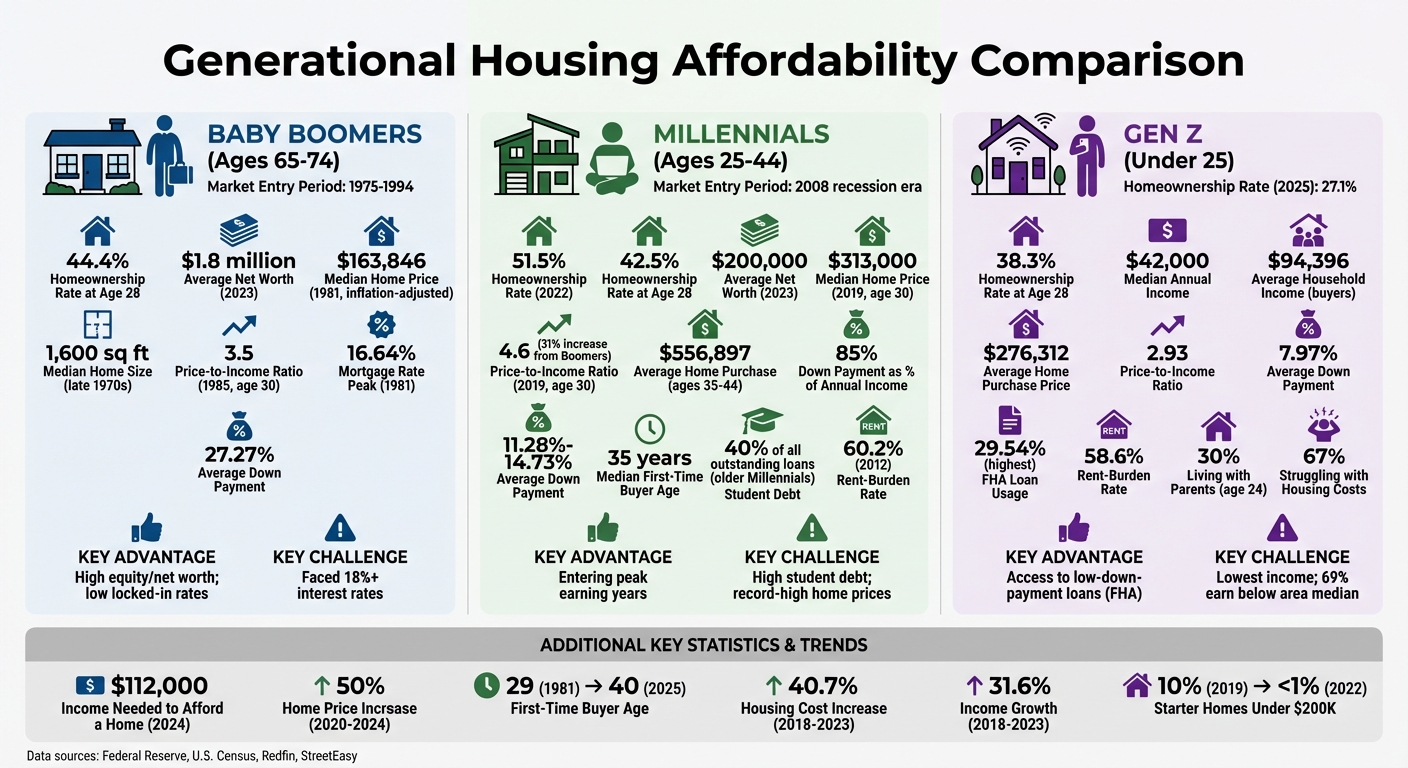
Housing Affordability Comparison Across Baby Boomers, Millennials, and Gen Z
1. Baby Boomers
Housing Affordability
Baby Boomers stepped into the housing market between 1975 and 1994, navigating some of the toughest mortgage burdens among generations still living today. During this time, mortgage payments consumed about 33% of the median household income. The 1981 recession made things even tougher, with mortgage payments spiking to nearly 54% of household income.
The main culprit? Skyrocketing interest rates. Mortgage rates jumped from 8.86% in 1976 to a staggering 16.64% in 1981. To put it in perspective, in 1981, the average mortgage payment consumed 47.91% of a median worker's pre-tax income. Adding to the strain, unemployment soared to 10.8% in 1982, making it even harder for many to achieve housing stability.
While interest rates were the primary hurdle, home prices were relatively moderate at the time, and home standards were evolving.
Price-to-Income Ratios
Even with high interest rates, inflation-adjusted home prices were relatively manageable. From 1976 to 1985, the average new home cost about $180,000 in today’s dollars. In 1981, the median price for a new home was roughly $163,846 (adjusted for inflation), with typical monthly payments around $1,830 in current dollars.
Homes back then were also simpler and smaller than today's. The median new home was about 1,600 square feet - nearly half the size of the 2,400-square-foot median in 2022. Features we now take for granted were less common too. For instance, only about two-thirds of new homes in the late 1970s had whole-house air conditioning, compared to nearly 100% today.
This combination of lower home prices and simpler standards gave Boomers a chance to build equity over time.
Housing Accessibility
By entering the housing market early, Baby Boomers accumulated significant equity. Many now own their homes outright, contributing to their impressive average net worth of $1.8 million as of mid-2023.
2. Millennials
Housing Affordability
Millennials stepped into the housing market during the turbulence of the 2008 Great Recession. Many were just starting their careers, and the financial setbacks from that period still linger. By 2022, only 51.5% of Millennials owned homes, a stark contrast to the 56.5% of Baby Boomers in 1990 and the 58.2% of Gen X in 2006.
Saving for a home has become a heavier financial burden. A 20% down payment now equals about 85% of the average Millennial household's annual income, compared with just 64% for Baby Boomers at the same age. This financial squeeze has pushed the median age for first-time homebuyers to 35. Adding to the challenge, Millennials carry a significant portion of student debt - older Millennials alone account for 40% of all outstanding student loans in the U.S.
Income Growth
While 68% of Millennials earn more than their parents did at the same age, this increase hasn’t kept up with surging housing costs. From 2018 to 2023, housing costs rose by 40.7%, while incomes only grew by 31.6%. Adjusted for inflation, the median household income in the U.S. has only seen a 7% total increase since 2000, averaging a modest 0.3% per year.
To comfortably afford a home at the recommended 2.6 price-to-income ratio, Millennials would need a household income of $120,400 - a staggering 75% higher than the actual median income of $68,700 recorded in 2019. This gap between income growth and housing costs has created significant financial hurdles for this generation.
Price-to-Income Ratios
The growing price-to-income ratios have made housing less accessible for Millennials compared to previous generations. In 1985, when the average Boomer was 30, the median home price was $82,800, and the median household income was $23,620, resulting in a ratio of 3.5. Fast forward to 2019, when Millennials hit 30, the median home price had skyrocketed to $313,000, while the median household income was $68,700, leading to a ratio of 4.6 - a 31% increase from what Boomers faced.
Older Millennials (ages 35–44) are now purchasing the priciest homes of any age group, averaging $556,897 with a price-to-income ratio of 3.23. By the end of 2022, the median sales price for new houses reached $457,800, and between March 2020 and March 2024, home prices surged by nearly 50%.
Housing Accessibility
Stagnant income growth and rising price-to-income ratios have nearly erased the concept of the "starter home." In 2019, homes priced under $200,000 made up 10% of the market. By 2022, that figure had plummeted to less than 1%. Domonic Purviance, a Subject Matter Expert at the Federal Reserve Bank of Atlanta, aptly summarized the situation:
"If you make the median income, there is no new housing that's available for you. Now, a new house is a luxury product."
Faced with these challenges, Millennials have adjusted their lifestyles. About 37% dine out less, 16% skip meals, and 15% live with their parents to save money. By mid-2023, the average Millennial household net worth stood at around $200,000, a stark contrast to the $1.8 million average for Baby Boomers.
In response to this housing crisis, the market has shifted toward "built-for-rent" single-family homes, with over 100,000 units completed in 2024. For those unable to pursue traditional homeownership, alternatives like Coliving.com offer fully furnished, all-inclusive housing with utilities, high-speed internet, and cleaning services, providing a practical solution in a market where starter homes are becoming rare.
3. Gen Z
Housing Affordability
Gen Z is grappling with a tough housing market, with 67% finding it hard to cover housing costs despite earning a median annual income of $42,000. This income level doesn't keep pace with soaring living costs, creating greater financial strain than for Baby Boomers or Millennials.
In 2025, the homeownership rate among Gen Z hit 27.1%, up from 26.1% the year before. Yet at age 28, only 38.3% of Gen Zers own homes, lagging behind Gen Xers (42.5%) and Baby Boomers (44.4%) at the same age. Among renters, 58.6% are considered rent-burdened, spending over 30% of their income on housing. While this is slightly better than Millennials’ 60.2% rent-burden rate in 2012, it still reflects a significant challenge.
To cope, many Gen Zers are taking drastic steps. About 18% have picked up side gigs, 20% sell personal belongings, 15% have moved back in with their parents, and 18% have even skipped meals to keep up with housing payments. Kenny Lee, Senior Economist at StreetEasy, put it bluntly:
"The experience of struggling to pay rent on an entry-level salary is familiar to so many of us that it's almost become normalized in our society. But this is something that should not be normal."
Income Growth
While Gen Z earns more in real terms than previous generations, their income growth hasn't kept pace with rising homeownership costs. Today, buying a median-priced home requires an annual income of around $112,000 - roughly $25,000 more than the median household income. Among Gen Z homebuyers, the average household income is $94,396, the lowest of any age group in the market, with 69.29% earning less than their area's median income.
Pandemic-era stimulus checks and student loan relief provided some financial breathing room, enabling a few to save for down payments. However, uncertainties like inflation, job stability, and high interest rates continue to push homeownership out of reach for many. These economic hurdles show up in Gen Z's price-to-income ratios, highlighting how steep the climb is for this generation.
Price-to-Income Ratios
For Gen Zers who do manage to buy a home, the average price-to-income ratio is 2.93. This is based on an average home purchase price of $276,312 and a household income of $94,396. The average mortgage loan amount is $249,761, and 29.54% of Gen Z buyers rely on FHA loans, more than any other generation. These loans allow for lower down payments, averaging just 7.97%, compared to 27.27% among Late Baby Boomers.
Still, these numbers only tell the story of those who have entered the market. Many Gen Zers remain priced out, so they seek more affordable housing in cities like Clarksville, TN; Goose Creek, SC; and San Antonio, TX. Even buyers often face limited choices due to budget constraints.
Housing Accessibility
Skyrocketing prices are forcing Gen Z to make tough decisions about where and when to buy, as well as the type of home they can afford. In 2025, individuals aged 19–29 accounted for 18.5% of home purchases, up from 14.4% in 2024. However, many delay buying until conditions improve. Over 30% of 24-year-old Gen Zers live with their parents or in-laws, compared to just 15% of Baby Boomers at the same age.
Asad Khan, Senior Economist at Redfin, highlighted the trade-offs Gen Z faces:
"The reality is that with housing costs still historically high, many young Americans are making compromises on location, size, or timing to get their foot in the homeownership door and start building equity."
For those unable to buy, alternative housing models are becoming more appealing. Platforms like Coliving.com offer a cost-effective option: fully furnished, all-inclusive spaces starting at $100 per month in over 380 cities. These setups include utilities, Wi-Fi, and cleaning services, helping Gen Z renters manage expenses while working toward their long-term financial goals.
Pros and Cons
Across generations, each group faces its own mix of challenges and advantages when balancing housing costs with income.
Baby Boomers have a unique edge, thanks to the equity they've built over time and their locked-in low mortgage rates. While they endured sky-high interest rates, over 18%, in the early 1980s, their accumulated wealth now puts them in a stronger position than younger generations.
Millennials, on the other hand, are navigating a much tougher market. They’re dealing with soaring home prices and heavy student debt. Late Millennials (ages 35–44) are particularly impacted, having purchased homes in 2024 at an average price of $556,897. This high cost, coupled with significant debt, limits their ability to save for larger down payments. Treasury Secretary Janet Yellen captured the situation perfectly:
"This supply crunch has led to an affordability crunch."
Gen Z is finding opportunities through low-down-payment programs, with 29.54% of their home purchases in 2024 backed by FHA loans, the highest rate of any generation. These programs allow them to enter the market with average down payments of just 7.97%. However, they face a steep income gap: 69.29% earn less than their area's median income. With an average household income of $94,396, many Gen Z buyers must compromise on location, home size, or timing to achieve homeownership.
Here’s a breakdown of these generational trade-offs:
| Generation | Primary Advantage | Primary Disadvantage | Avg. Down Payment |
|---|---|---|---|
| Baby Boomers (65–74) | High equity/net worth; low locked-in rates | Faced 18%+ interest rates in the past | 27.27% |
| Millennials (25–44) | Entering peak earning years (Late Millennials) | High student debt; record-high home prices | 11.28%–14.73% |
| Gen Z (<25) | Access to low-down-payment loans (FHA) | Lowest income; 69% earn below area median | 7.97% |
This evolving housing landscape shows how Boomers tap their equity, Millennials struggle with financial hurdles, and Gen Z relies on government-backed loans to enter the market. For younger buyers facing tough financial barriers, alternative housing solutions, like flexible, all-inclusive coliving spaces offered by Coliving.com, offer a modern option that aligns with today’s lifestyles in the United States.
Conclusion
Housing affordability has declined sharply from the Baby Boomer generation to Gen Z. While Baby Boomers benefited from accrued equity, Millennials and Gen Z face tighter budgets and rising costs. Inflation-adjusted home prices have jumped roughly 65% between 2000 and 2024, yet median household income has barely budged. Today, 67% of Gen Z adults report struggling to cover housing costs, compared to 53% of Millennials and just 36% of Baby Boomers.
From 2000 to 2020, housing demand rose 26%, but supply grew only 19%. The U.S. Department of the Treasury attributes this imbalance to demographic-driven demand outpacing supply. This shortage has pushed the average age of first-time homebuyers to 40 years in 2025, up from 28 years in 1991.
Tackling this crisis requires both sweeping reforms and practical personal strategies. On a policy level, strengthening the Low-Income Housing Tax Credit (LIHTC) and revising restrictive zoning laws could unlock more multifamily housing options. Urban planners are exploring creative solutions like converting office spaces into residential units, with over 90,000 such units currently in development. Additionally, the Treasury has committed $100 million over three years through the CDFI Fund to support affordable housing initiatives.
Individually, people are finding ways to adapt. About 15% of Gen Zers have moved back in with their parents to save on housing costs. Others are relocating to more affordable cities or choosing smaller homes to build equity sooner. Flexible coliving spaces, like those offered by Coliving.com in over 380 cities worldwide, offer another cost-effective option, with prices starting as low as $100 per month. These community-focused housing solutions are especially appealing to young professionals and remote workers.
The way forward combines systemic changes with personal compromises. As Asad Khan, Senior Economist at Redfin, puts it:
"The reality is that with housing costs still historically high, many young Americans are making compromises on location, size, or timing to get their foot in the homeownership door and start building equity."
FAQs
Why are home prices rising faster than incomes?
Housing costs are rising faster than incomes, driven by higher median home prices and a growing income-to-price ratio. In some high-cost markets, this ratio can hit 8-to-1 or more, making it harder for people to afford homes based on their earnings. This growing disparity is especially pronounced in areas where housing is already expensive, underscoring the challenge of keeping up with escalating costs.
How do mortgage interest rates affect affordability across generations?
Mortgage interest rates significantly impact housing affordability by shaping monthly payments and overall borrowing costs. When rates climb, monthly payments rise, making it harder for many, especially Millennials and Gen Z, to afford homes. On the flip side, lower rates reduce payments, making homeownership more attainable and helping more people qualify for loans. Recent rate declines have provided some relief for younger buyers, offering a cushion as they face rising housing costs.
What can younger adults do if buying a home isn’t realistic right now?
If purchasing a home feels out of reach, younger adults might consider more budget-friendly and adaptable living options, such as coliving. These spaces often come fully furnished and include utilities, Wi-Fi, and cleaning services in the rent, making them an all-in-one way to cut costs. Shared apartments and rental housing are also great alternatives, offering lower upfront costs and the flexibility to save for a future home purchase. These choices can provide stability, especially during periods of high housing costs and economic uncertainty.