
Coliving success starts with understanding residents' needs, not assumptions. Here's what the data reveals about why people choose coliving and how operators can meet their expectations:
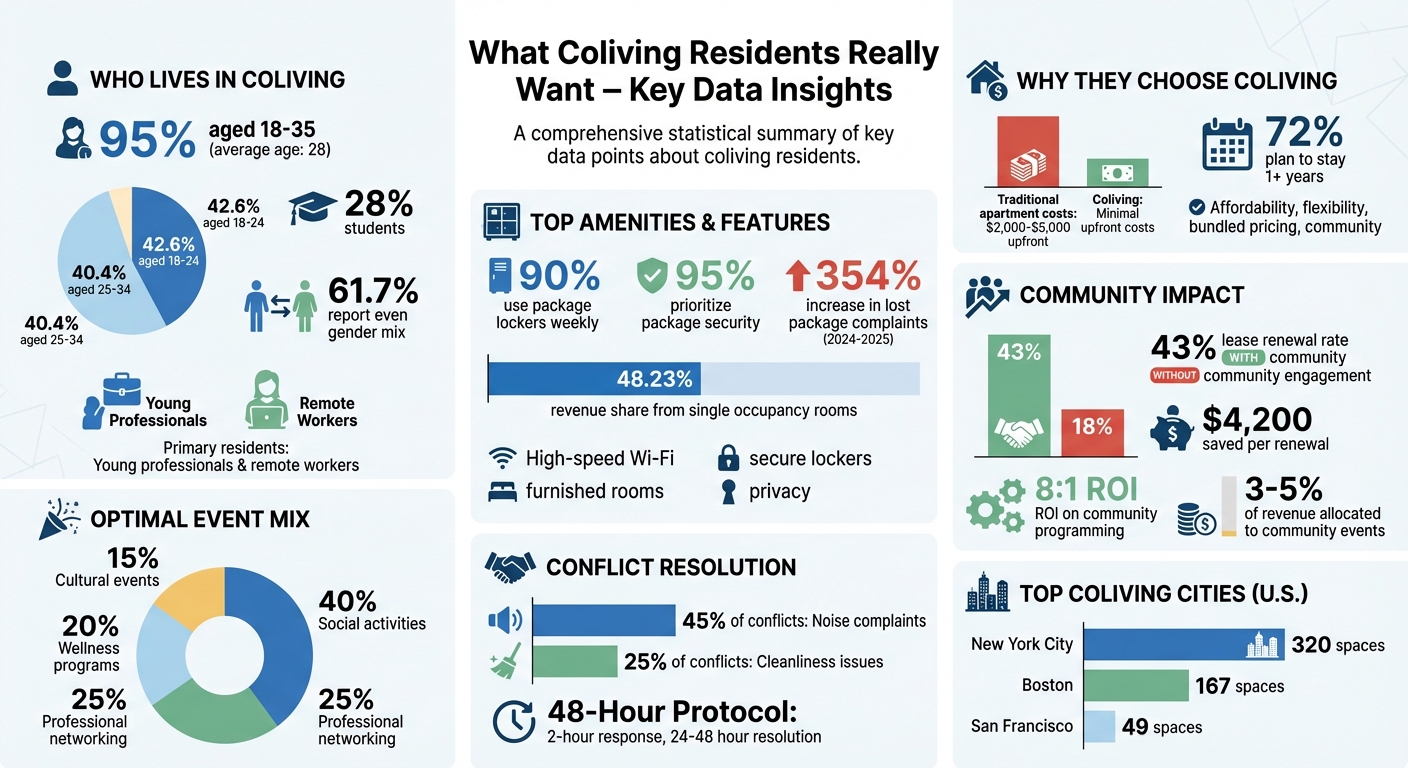
- Who lives in coliving spaces? Primarily young adults (95% aged 18–35), with professionals and remote workers making up the majority.
- Why do residents choose coliving? Affordability, flexibility, bundled pricing, and community are key drivers.
- Top amenities residents expect: High-speed Wi-Fi, secure package lockers, fully furnished rooms, and privacy.
- What keeps them engaged? Community events (e.g., social, networking, wellness activities) and tech-enabled conveniences like apps for maintenance and keyless entry.
- Retention matters: Properties with strong community engagement see 43% lease renewal rates, compared to 18% without.
Operators can save thousands by focusing on what residents value most: convenience, connection, and clear communication. By investing in essential features, offering flexible leases, and prioritizing community-building, coliving spaces can boost satisfaction and profitability.
Coliving Resident Demographics and Preferences Data 2024-2025
Who Lives in Coliving Spaces and Why
Coliving Resident Demographics
Coliving spaces primarily attract young adults, with 95% of residents falling within the 18–35 age range and an average age of 28. Breaking it down further, 42.6% are aged 18–24, while 40.4% are in the 25–34 bracket.
Interestingly, students only make up 28% of coliving residents in places like the UK. The majority are young professionals and remote workers who appreciate the flexibility coliving offers for their careers. Digital nomads are another key group, drawn to the convenience of "plug-and-play" setups that include coworking spaces and reliable high-speed internet.
Gender representation is fairly balanced, with 61.7% of operators noting an even mix of male and female residents. This diversity fosters dynamic and social living environments, making coliving more than just a roof over one’s head.
Main Reasons People Choose Coliving
Affordability is often the hook, but what keeps people interested is the combination of financial ease and unmatched flexibility. Comparing coliving vs. renting traditional apartments can be daunting, with upfront costs like security deposits, first and last month’s rent, and furniture adding up to $2,000–$5,000 or more. Coliving spaces remove these hurdles, offering minimal upfront costs and lease terms as short as a week or as flexible as month-to-month arrangements. This appeals especially to remote workers and professionals who prefer mobility over long-term leases.
The convenience of bundled pricing - covering rent, utilities, internet, and amenities in a single monthly fee - adds to the appeal. It eliminates the hassle of juggling multiple bills or worrying about surprise expenses.
Despite the perception that coliving is for short stays, 72% of residents in the UK plan to stay for at least a year. This shows that once people experience the affordability, convenience, and sense of community, they’re likely to stick around. It’s a combination that traditional apartments often struggle to compete with.
What Residents Want: Amenities and Features
Required Amenities
Today's residents expect more than just a roof over their heads - they want convenience and security baked into their living experience. Essentials like high-speed Wi-Fi, fully furnished rooms, and secure package management are non-negotiable. In fact, over 90% of residents use package lockers weekly, with 95% stressing the importance of package security. With complaints about lost packages from off-site delivery services skyrocketing by 354% between 2024 and 2025, smart parcel lockers have transitioned from a "nice-to-have" to an absolute must.
Privacy is also a top priority. Single occupancy rooms captured a 48.23% revenue share in 2024, underscoring the demand among professionals for spaces that support both productivity and personal downtime. On top of that, bundled utilities and cleaning services are now standard expectations - residents don’t want to be caught off guard by surprise fees.
Different generations bring different priorities to the table. Gen Z leans heavily on speed and tech, favoring AR/VR-ready Wi-Fi and cutting-edge solutions. Millennials, on the other hand, seek a balance of security, affordability, and efficiency. Students are all about cost and proximity to their universities, while working professionals gravitate toward upscale wellness amenities and coworking areas designed for focus and collaboration.
While these essentials are critical, it’s the extra touches that truly enhance the coliving experience.
Additional Features That Add Value
Beyond the basics, amenities like rooftop gardens and smart home technology can significantly boost resident satisfaction and retention. Features such as swimming pools and advanced smart tech are particularly appealing in midrange and luxury properties, where residents are willing to pay more for added comfort. For example, in March 2024, Habyt unveiled a five-story development in Leipzig, Germany, offering 185 fully furnished units, a rooftop terrace, and a courtyard that seamlessly combines private living with communal workspaces.
Community engagement, however, often outweighs physical amenities when it comes to retention. Operators are encouraged to dedicate 3–5% of their total revenue to community programming, with a focus on creating a balanced mix of events: 40% for social activities, 25% for professional networking, 20% for wellness, and 15% for cultural experiences.
"Community isn't a cost center - it's your competitive advantage, your retention engine, and your growth strategy all in one." – Maria Gonzalez, VP of Community Operations, Common Living
Tech-enabled solutions are another major draw for residents. Features like apps for maintenance requests, event sign-ups, keyless entry, and seamless digital interactions simplify daily life. The growing trend of "affordable luxury" in 2025 - think high-end communal kitchens, biophilic designs, and custom workspaces - offers residents a sense of premium quality without the premium price tag.
How Community and Location Affect Resident Choices
Creating Strong Communities
Community isn’t just an added perk - it’s the heart of coliving. Properties that focus on fostering social connections see a 43% lease renewal rate, compared to only 18% for those that don’t. This difference isn’t just about happier residents; it’s also about saving money. Each renewal can save operators approximately $4,200 in marketing, vacancy, and turnover costs, making community-building a financially smart move.
The secret to building a thriving community lies in intentional design and active engagement. For starters, 94% of operators agree that carefully matching roommates is critical to avoiding conflicts and ensuring a positive living experience. It’s no surprise that the most successful operators hire community managers with backgrounds in hospitality or education - fields that focus on fostering relationships rather than just maintaining properties.
But it’s not all about fun events and social calendars. Addressing conflicts quickly and effectively is just as important. Noise complaints, for example, make up 45% of all resident conflicts, followed by cleanliness issues at 25%. The best operators use a 48-Hour Protocol, responding to conflicts within 2 hours and delivering a resolution plan within 24–48 hours. This swift action helps maintain trust and keeps residents happy. Clear house rules, such as quiet hours from 10 PM to 8 AM, also set upfront expectations and reduce potential friction.
A well-built community doesn’t just improve life inside the property - it also complements the lifestyle offered by the location.
Where Residents Want to Live
While a strong community is essential, the property’s location plays a huge role in attracting residents by balancing convenience with lifestyle needs. For many, cost savings and social opportunities are equally important when choosing coliving. Proximity to city centers, public transit, and walkable neighborhoods often tips the scale. For example, coliving spaces near USC cost $1,000–$1,500 per month, compared to traditional apartments that average around $2,500 - making coliving a much more affordable option in urban areas.
Globally, Europe leads the coliving market, with 47.5% of all operators concentrated there. Cities like London, Paris, Berlin, and Amsterdam are at the forefront. In the U.S., New York City takes the top spot with 320 coliving spaces, followed by Boston with 167 and San Francisco with 49. These cities are popular for their excellent transit systems, vibrant social scenes, and proximity to major employers and universities.
Increasingly, residents are drawn to properties near health centers, parks, and areas with low air pollution, reflecting a growing interest in wellness-focused living. Properties close to natural environments and outdoor spaces are especially appealing. With hybrid work becoming the norm, residents are looking for locations that offer the best of both worlds - easy access to business districts and entertainment hubs.
"The feedback we receive is that a sense of community and events is key, as is the flexibility and length of stay." – Katherine Rose, Managing Director, Verv Life
How Operators Can Use This Data
Matching Your Space to Resident Needs
To stay ahead of the curve, align your property’s features with what residents actually want. Start by evaluating your amenities against the data. For example, 90% of residents use smart parcel lockers weekly, while 95% rank package security as a top concern. If your property still relies on office pick-up for packages, you might be creating unnecessary hassle - and missing an opportunity to upgrade.
For smaller properties (under 10 units), residents prioritize essentials like safe neighborhoods, air conditioning, and in-unit washers and dryers. Meanwhile, in larger buildings (50+ units), high-speed internet becomes a must-have. These aren’t extras - they’re baseline expectations. Focus your investments on features that residents use regularly, rather than on flashy but underutilized amenities.
Don’t overlook the power of community programming. Properties with high retention rates typically allocate 3–5% of revenue to events and activities. Take this example: In November 2024, a 180-resident property in Austin, TX, hosted 22 events - including "Taco Night" and resume workshops - on a $1,595 budget (about $8.86 per resident). The result? A 68% event participation rate and a 47% lease renewal rate, far outperforming the 18% industry average for properties without programming. With an estimated 8:1 return on investment, community initiatives clearly pay off, especially with a $30,000 annual budget for a 150-bed property.
To keep engagement high, diversify your events using the 4-Category Event System:
- 40% social activities (e.g., game nights or happy hours)
- 25% professional development (e.g., workshops or networking events)
- 20% wellness programs (e.g., yoga or fitness classes)
- 15% cultural events (e.g., holiday celebrations or art showcases)
This balanced approach ensures you meet a range of resident interests while fostering a sense of community. These efforts not only satisfy resident needs but also set the stage for stronger retention rates. Next, let’s explore how quick responses and flexible options can further reduce turnover.
Keeping Residents Happy and Reducing Turnover
Once your property meets residents’ expectations, focus on reducing turnover by acting quickly and offering flexible solutions. Retention is key to profitability. Properties with strong community engagement can boost lease renewals from 18% to 43%, leading to significant cost savings.
A rapid-response protocol is essential for maintaining trust and addressing issues before they grow. The first 90 days are especially critical. Welcome new residents within 24 hours, introduce roommates promptly, and monitor their social connections. Use quarterly surveys to track your Social Connection Index - if residents report having fewer than three friends, it could signal a risk of churn that needs immediate attention.
Flexibility in lease terms can also make a big difference. Offer options ranging from 30-day to 12-month leases, and simplify things with all-inclusive pricing that bundles utilities, cleaning, and other amenities into one bill.
For larger properties (100+ beds), hiring a full-time Community Manager can be a game-changer. Look for candidates with backgrounds in hospitality or education - they excel at managing group dynamics and fostering engagement. Salaries typically range from $45,000–$60,000 for properties with 50–100 beds and $70,000–$95,000 for properties with 200+ beds. Retention-based bonuses can further incentivize performance. This role often pays for itself through improved renewals and reduced turnover rates.
Final Thoughts
Today’s residents expect convenience, a sense of community, and flexibility. Coliving properties that succeed don’t rely on guesswork - they rely on data. For example, properties that allocate 3–5% of their revenue to community programming often achieve an impressive 8:1 return on investment. On the other hand, those that neglect resident engagement can face renewal rates as low as 18%.
The difference between thriving and struggling properties often comes down to one thing: a people-first focus. As Maria Gonzalez, VP of Community Operations at Common Living, explains:
"You're not in the real estate business. You're in the people business that happens to involve real estate. Community isn't a cost center - it's your competitive advantage."
This philosophy is what separates successful coliving spaces from those that treat their operations like traditional rentals.
The best operators focus on measurable results. Key metrics like Event Participation Rate (aim for 65–75%), Net Promoter Score (target 50–70), and Conflict Resolution Time (under 24 hours) are essential for assessing the health of your community. Engaged residents, for instance, are 4.6 times more likely to provide referrals, which can significantly reduce acquisition costs.
Once you’ve tracked these metrics, refine your offerings. Start with essentials like high-speed internet and smart parcel lockers, which residents rely on daily. Then, introduce structured programming using the 4-Category Event System to keep engagement fresh and varied. When conflicts arise, respond within 2 hours and provide a resolution plan within 24–48 hours to build and maintain trust.
As coliving helps address the housing crisis and the industry evolves, institutional investors expect professional, data-driven operations. Outdated tools like spreadsheets and a disregard for community priorities won’t cut it. Instead, use resident data to adapt to their needs and create spaces where people want to stay. A data-focused approach doesn’t just manage rentals - it creates thriving, resident-centered communities.
FAQs
What amenities should I prioritize first?
For remote workers, having high-speed, reliable internet isn't just a perk - it's a necessity. It's the backbone of productivity, enabling seamless video calls, quick downloads, and uninterrupted workflows.
Beyond connectivity, residents are also drawn to community-building features that promote interaction and foster a sense of belonging. Whether it's shared spaces, organized events, or simply opportunities to connect, these elements make a coliving space feel more like home.
Lastly, a convenient location remains a top priority. Easy access to public transportation, nearby shops, or vibrant local attractions can significantly enhance the overall experience for residents. Together, these amenities cater to the practical and social needs of coliving communities, ensuring a balanced and fulfilling lifestyle.
How much should I budget for community events?
The budget for hosting community events in coliving spaces depends on the size of the community and the range of planned activities. Operators who see success often dedicate anywhere from a few hundred to several thousand dollars each month to fund events like social gatherings, wellness programs, or skill-sharing workshops. These investments do more than just fill the calendar - they help build a sense of belonging and improve resident retention. In fact, communities with robust programming have seen renewal rates climb to 43%, compared to just 18% in spaces without such efforts. For larger spaces, budgets should be scaled to meet the increased demand.
Which metrics best predict renewals?
Community engagement and resident satisfaction play a crucial role in predicting lease renewals. Data shows that residents involved in active community programs have a renewal rate of 43%, while those without access to such initiatives renew at only 18%. Creating a sense of connection and belonging within the community makes a noticeable difference in retention rates.

